How Fire Made Us Human: 9 Surprising Facts About Our First Superpower
When did our ancestors first use fire, and what did it change? Nine surprising facts from the first chapter of An Almanac of Us, from chimpanzees that read grass fires to the oldest fire-making kit, and what scientists still argue about.
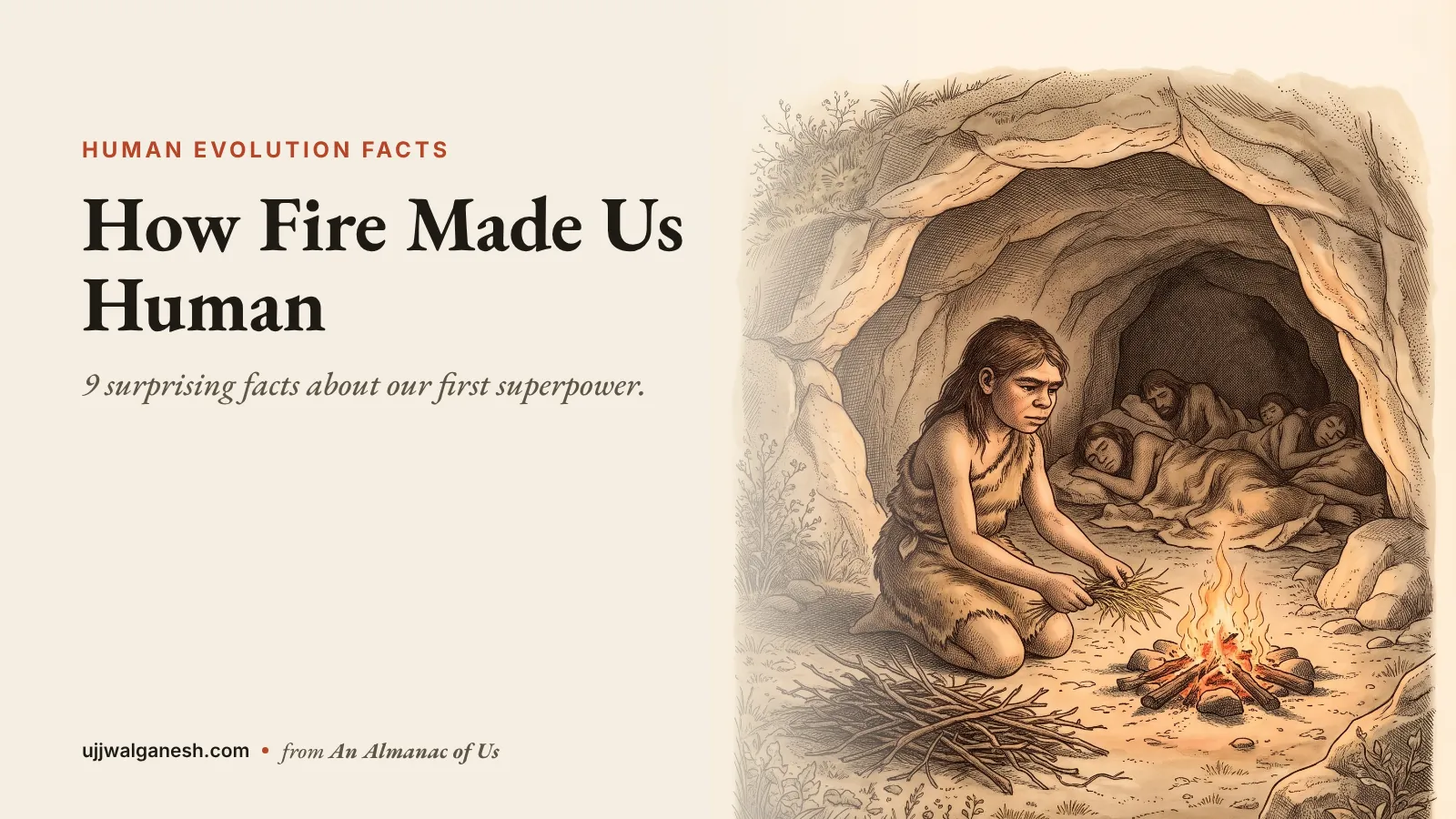
About a million years ago, in a cave in what is now South Africa’s Northern Cape, someone kept a fire burning. We know because archaeologists, working with microscopes, have found ash from burned plants and tiny pieces of burned bone about thirty metres inside that cave, too deep for a bush fire on the hillside to have blown them in.
That is where the first chapter of my book An Almanac of Us begins: with a girl of about twelve, from a species a little different from ours, trusted for the first time to keep the fire going until morning. If it went out, nobody in her band knew how to light it again.
Fire was our first borrowed superpower. No other animal has ever kept a fire alive, fed it through the night and made a home around it. Here are nine facts from that chapter that show how strange, slow and important that was, along with the parts that scientists still argue about.
When did humans start using fire?
The short answer: the first clear signs of fire in places where our ancestors lived are about a million years old. Fire turns up, then vanishes again for long stretches, until somewhere between about 400,000 and 300,000 years ago, when signs of regular fire use become common across Europe and western Asia. The oldest direct evidence that people could make fire, not just catch it from a wildfire, is about 415,000 years old.
So for hundreds of thousands of years, fire was something our ancestors had to find and keep, not something they could summon. That gap explains a lot about how hard it was to hold on to.
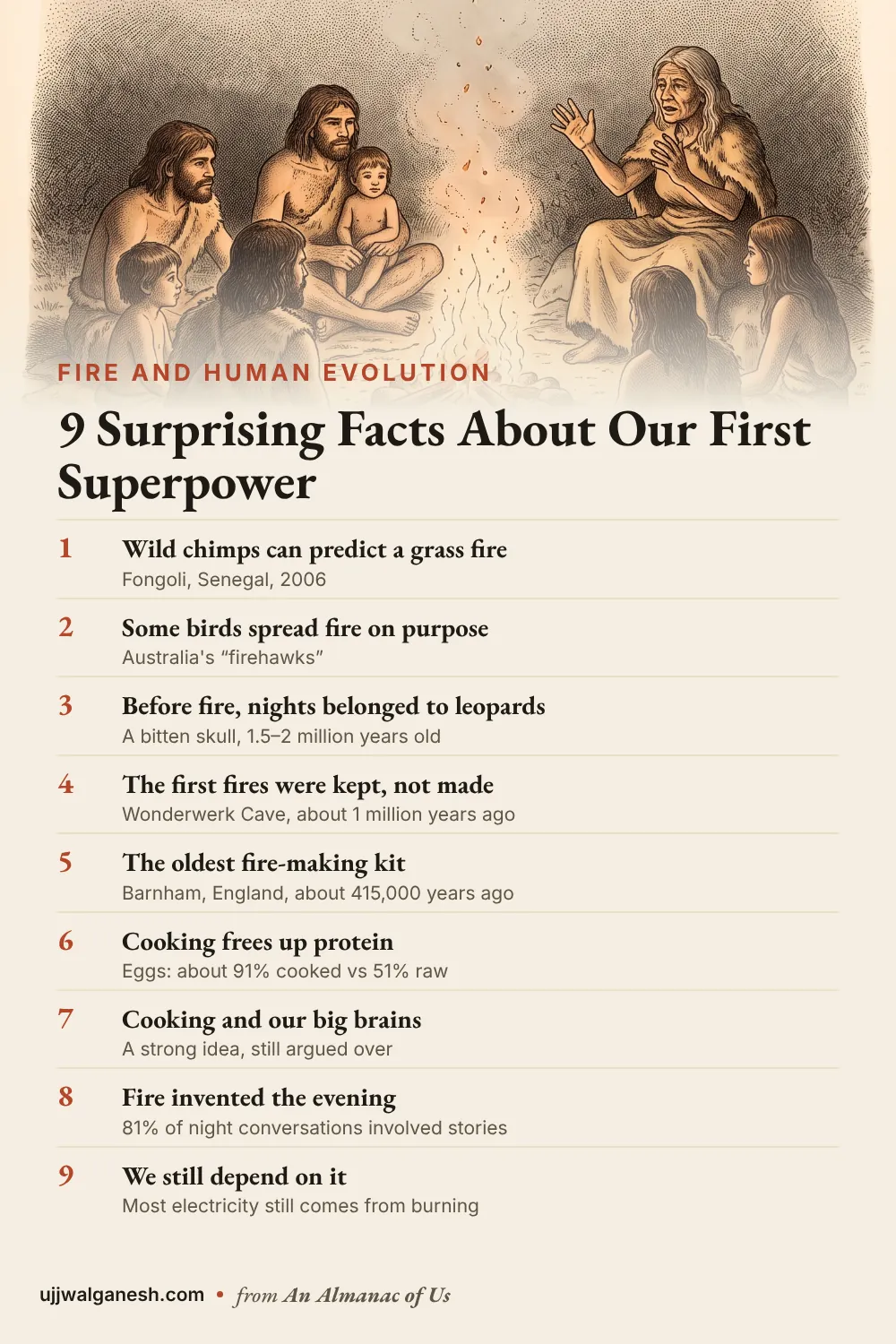
1. Wild chimpanzees can predict where a grass fire will go
In 2006, in the hot, open woodland of Fongoli in south-eastern Senegal, the primatologist Jill Pruetz was following a group of wild chimpanzees when a grass fire came through. They didn’t panic. They watched the flames and moved out of the way without hurrying. “They were experts at predicting where it was going to go,” she said afterwards.
Pruetz and a colleague suggested the road to fire had three steps: understand it, control it, and finally start it. The Fongoli chimpanzees seem to have taken the first step. Nobody has seen chimpanzees take the second.
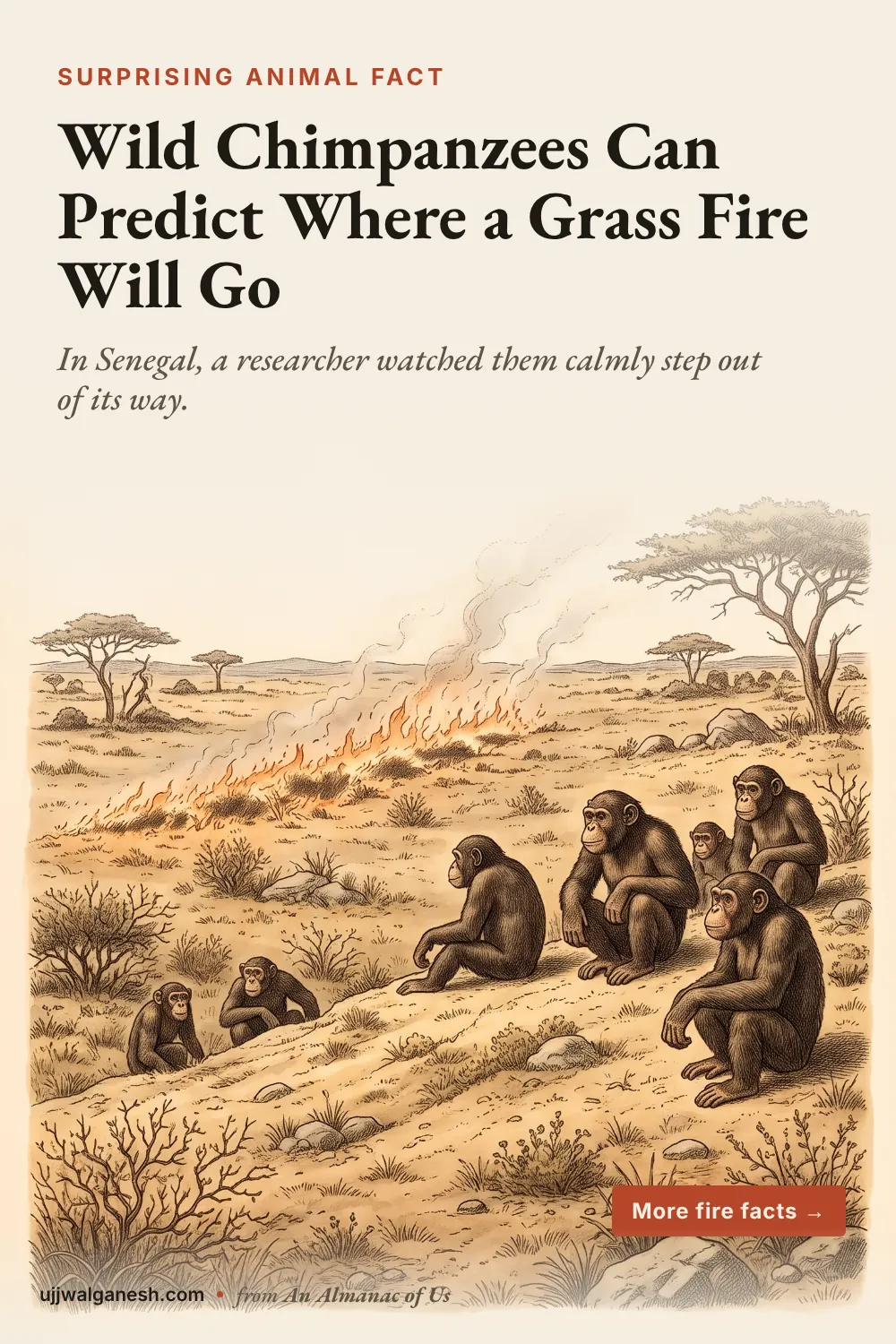
2. Some birds spread fire on purpose
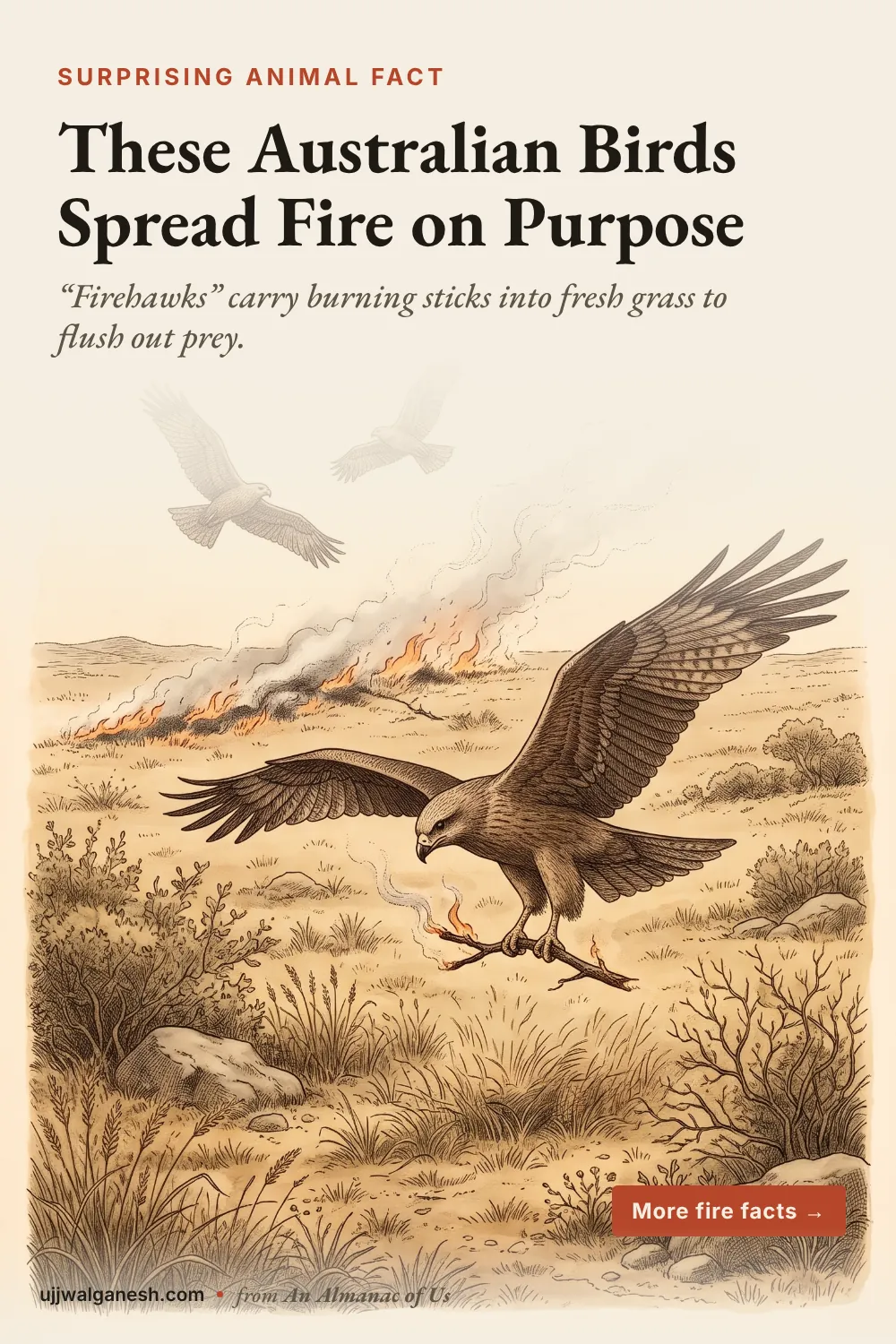
In northern Australia, Aboriginal people have long described black kites, whistling kites and brown falcons picking up burning sticks and dropping them into unburned grass, to flush out the insects, lizards and small animals they hunt. The birds are known as “firehawks”. Researchers gathered these accounts in a 2017 study, and some of them had seen the birds do it themselves.
So humans are not the only animals that use fire. We are the only ones that keep it.
3. Before fire, the night belonged to leopards
In Swartkrans Cave, near today’s Johannesburg, excavators found part of a skull from a young member of a species closely related to ours, roughly 1.5 to 2 million years old (estimates vary). Near the back are two small round holes. In 1970 the scientist C. K. Brain showed that they matched, almost exactly, the lower canine teeth of a leopard whose jaw was found in the same cave.
For a small, slow ancestor without claws, fangs or speed, the dark was dangerous. A fire changed the odds. At night it is a light, a heater and a guard that never sleeps, as long as someone keeps feeding it. The anthropologist Richard Wrangham thinks fire may be what finally let our ancestors come down from the trees and sleep on the ground.
4. The first fires were kept, not made
The oldest fires left very little behind: wood turns to ash, ash blows away, and one night’s fire can vanish in a season. So archaeologists look very closely, at flint that has cracked in the heat, bone that has burned black and then white, and thin layers of ash that only a microscope can see.
Looking closely can also take a fire away. For most of the twentieth century, textbooks said that “Peking Man” kept fires in the cave of Zhoukoudian near Beijing. In 1998 a team looked again with microscopes and chemical tests. They found burned bones, but no ash and no charcoal, and the “ash” layers turned out to have been laid down by water.
The best early evidence comes from Wonderwerk Cave, about a million years ago, and from the shore of an old lake in northern Israel, where people left burned seeds and wood, and small clusters of burned flint as if around hearths, about 790,000 years ago. In 2026 a team reported burned bones from even older layers at Wonderwerk, somewhere between about 1.1 and 1.8 million years old. If the new dating holds up, it would push the story back further. For most of this long stretch, people probably had to catch fire from lightning or a burning grassland, then keep it alive.
5. The oldest known fire-making kit is more than 400,000 years old
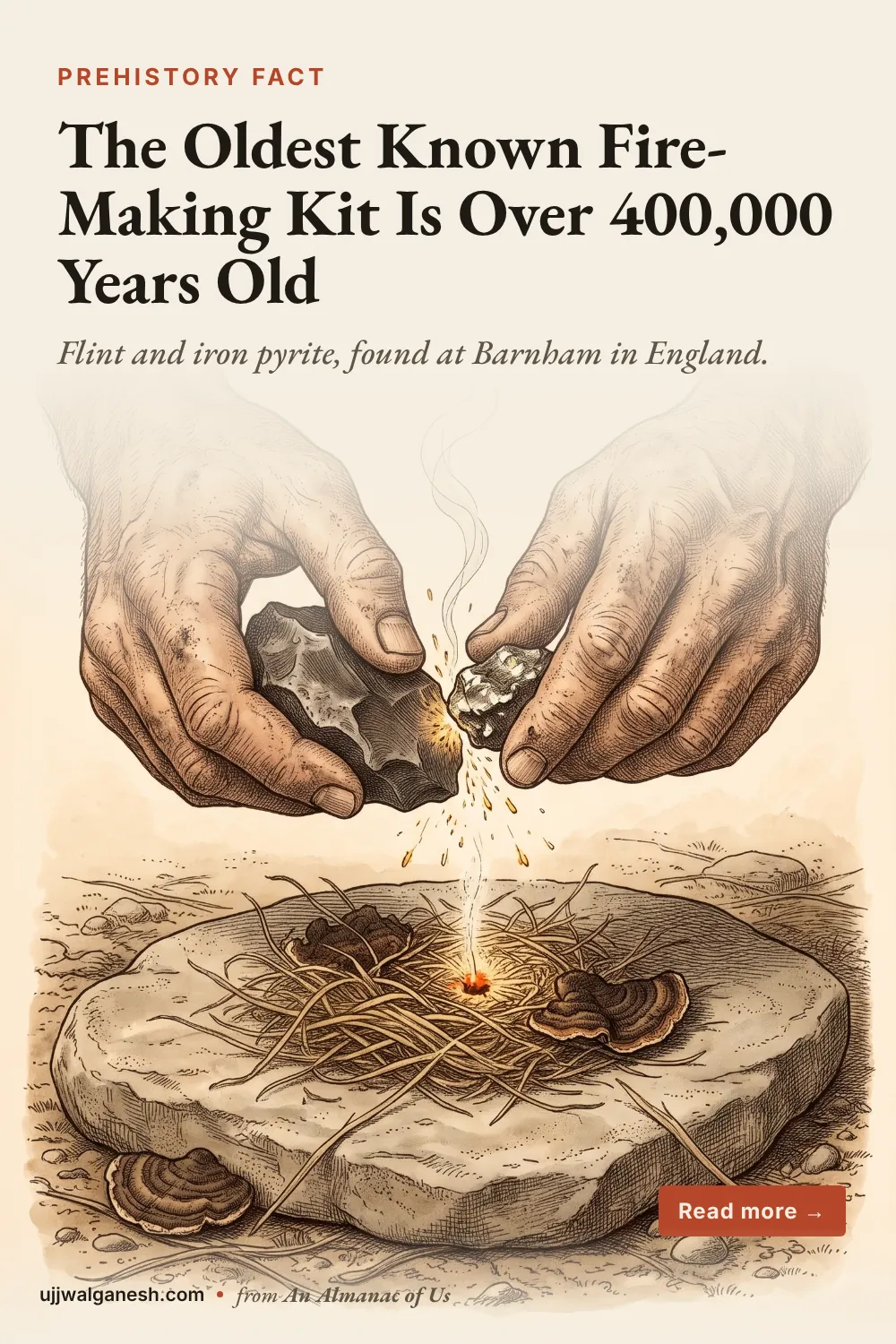
At Barnham, a village in eastern England, archaeologists found a patch of clay baked by repeated fires, flint tools cracked by heat and two small pieces of iron pyrite, a mineral that throws sparks when it is struck with flint. Pyrite is rare there, so someone probably carried it in on purpose. The burned layers are about 415,000 years old, and the fire-makers were probably early Neanderthals. Before this find, published in 2025, the oldest direct evidence of fire-making came from Neanderthal sites in France about 50,000 years old.
Making fire has to be learned. A spider is born able to spin a web; nobody is born knowing how to make a fire. If the people who knew how died, the skill could be lost. Most of us, dropped into a forest without matches, would spend a cold night.
6. Cooking turns fire into a stomach outside the body
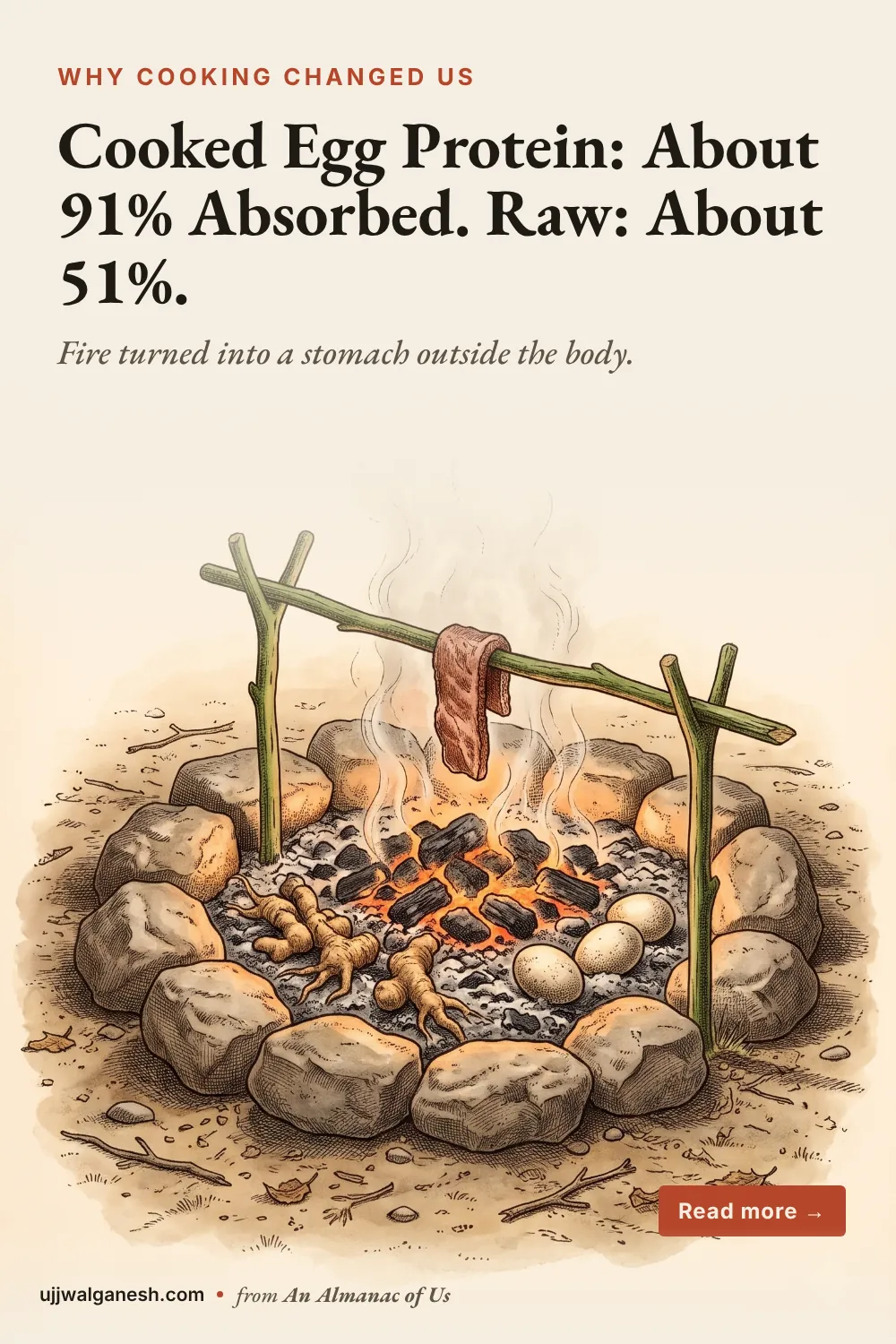
Heat does part of the work of digestion before food reaches the mouth. It softens tough roots, loosens the proteins in meat and turns hard grains of starch into a paste the body can use. It also kills many of the germs in raw meat.
Eggs show how big the difference can be. In a small Belgian study, about 91% of the protein from cooked eggs was digested and absorbed, against about 51% from raw eggs.
7. Cooking may explain our small gut and big brain, but that’s still argued over
For a primate our size, humans have a small gut and a large brain, and both organs use a lot of energy. In 1995 the anthropologists Leslie Aiello and Peter Wheeler proposed that our big brains were paid for by a smaller gut, and noted that cooking might help. Wrangham built that into a full theory: cooked food is easier to digest, so it needs less gut, and the energy saved could feed a bigger brain.
There are clues. In a 2011 study, chimpanzees spent more than a third of their day feeding, and an animal of our size and family would be expected to spend almost half. Modern humans spend about one-twentieth. And in a German survey of more than five hundred people who had switched to eating mostly or only raw food, the men had lost about ten kilograms on average and the women about twelve, despite living among supermarkets.
The argument is worth knowing, though. Our ancestors’ brains began to grow, and their teeth to shrink, about two million years ago. The clearest evidence of fire comes about a million years later. Wrangham’s answer is that early fires left few traces we haven’t found yet. Other researchers point out that slicing meat and pounding plants with stone tools also makes raw food easier to chew: in a 2016 study with volunteers, slicing and pounding alone cut chewing force by about 12% and the number of chews by about 5%. Even the brain-for-gut trade-off is disputed; a 2011 study across many mammals found no sign of it. Nobody has settled it. As I wrote in the book, the honest way to tell this story is to leave the gap in it.
8. Fire invented the evening
For most animals, darkness ends the day. Around a fire, it became a time of its own. Nobody could hunt or gather, so there was little to do but sit together and talk.
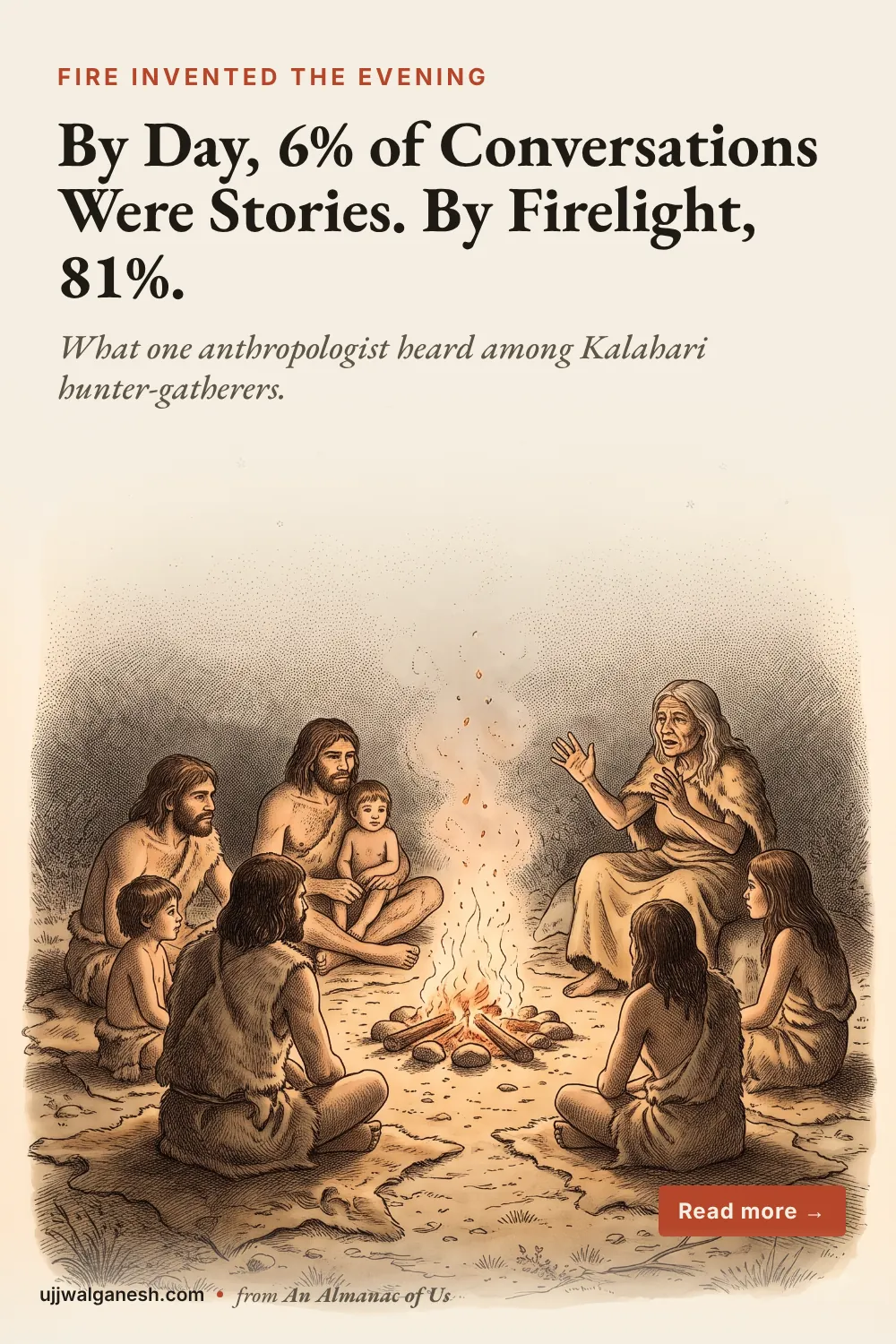
In 1974 the anthropologist Polly Wiessner wrote down 174 conversations among the Ju/’hoansi of the Kalahari, in north-western Botswana, who then lived mainly by hunting and gathering. By day, only 6% of their conversations were stories. Around the fire at night, 81% of conversations involved stories. “There is something about fire in the middle of the darkness that bonds, mellows and also excites people,” she said.
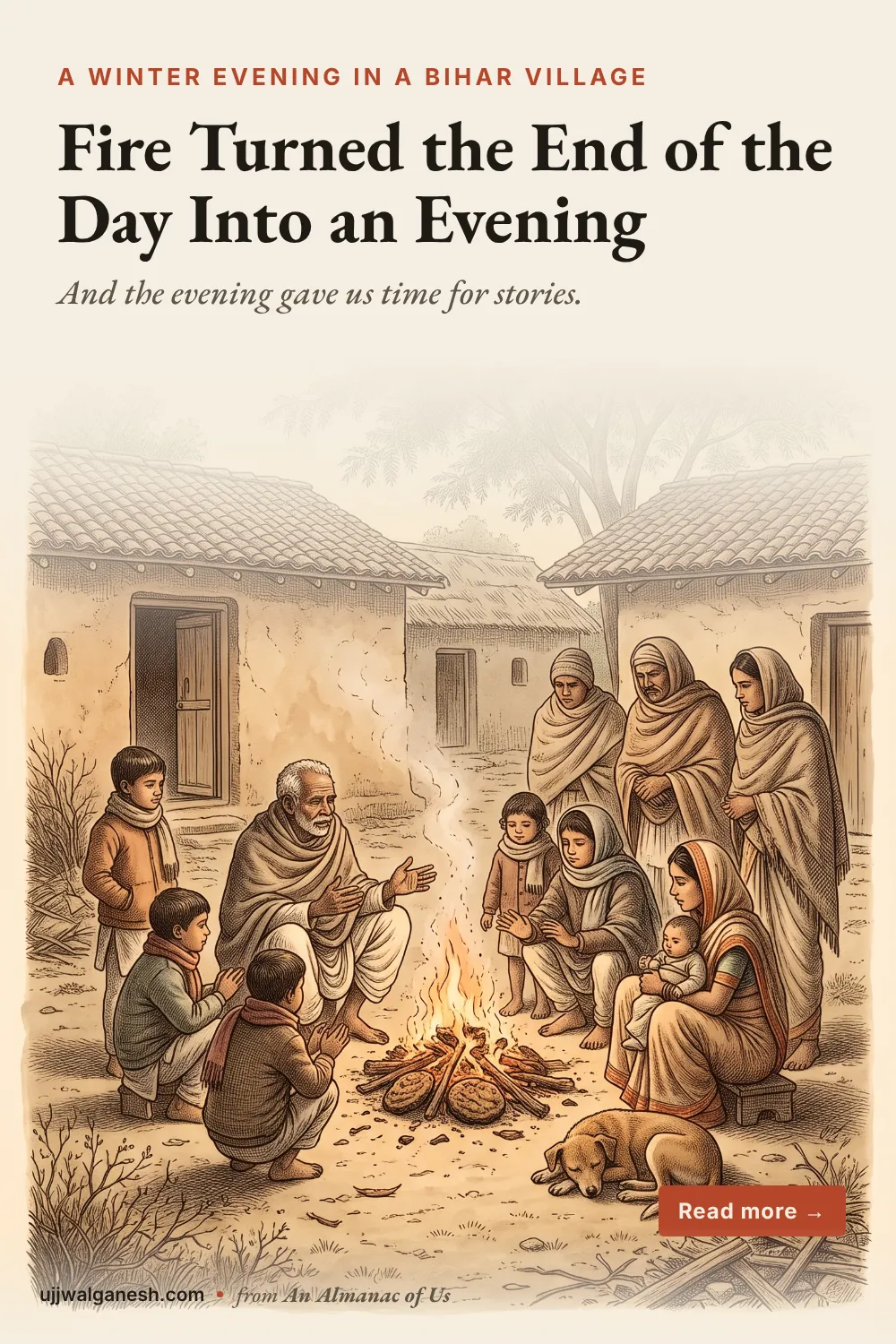
I know a little of what she meant. In winter in our village in Vaishali district, in Bihar, someone would heap up dry leaves, cow-dung cakes and firewood and light a ghoor, an open fire for warming people on cold evenings. Within minutes everyone gathered around it: neighbours, children, old people and the dogs too. The old ones told stories of their time. I could have sat there all night, my face hot and my back cold, just listening.
9. We still haven’t stopped depending on it
Once our ancestors’ bodies had adapted to cooked food, there was no way back. Fire may have been the first power our species came to depend on completely, and it was not the last.
It is still with us, mostly out of sight. About 2.1 billion people cook over open fires or on simple stoves that burn wood, dung or coal, and the World Health Organization estimates that the smoke caused about 2.9 million deaths in 2021. Most of the world’s electricity still comes from burning something. A tree builds its wood out of air, water and the energy of sunlight; burning runs that process backwards, and the stored sunlight comes out as heat and light. As the chapter puts it, we spent a million years swallowing the sun secondhand.
A short timeline of fire
Fire’s story starts long before our own species appears. For the whole of human history laid out on one scale, see my human history timeline.
| When | What happened | Where |
|---|---|---|
| Roughly 2 to 1.5 million years ago | A young hominin’s skull is bitten by a leopard; nights are dangerous | Swartkrans, South Africa |
| About 1 million years ago | The first clear signs of fire kept inside a cave | Wonderwerk Cave, South Africa |
| About 790,000 years ago | Burned seeds and wood, and clusters of burned flint as if around hearths | Northern Israel |
| About 415,000 years ago | The oldest direct evidence of making fire | Barnham, England |
| About 400,000 to 300,000 years ago | Regular fire use becomes common | Europe and western Asia |
| About 5,300 years ago | Ötzi carries a birch-bark container with charcoal, thought to hold embers | The Alps |
Go deeper: An Almanac of Us
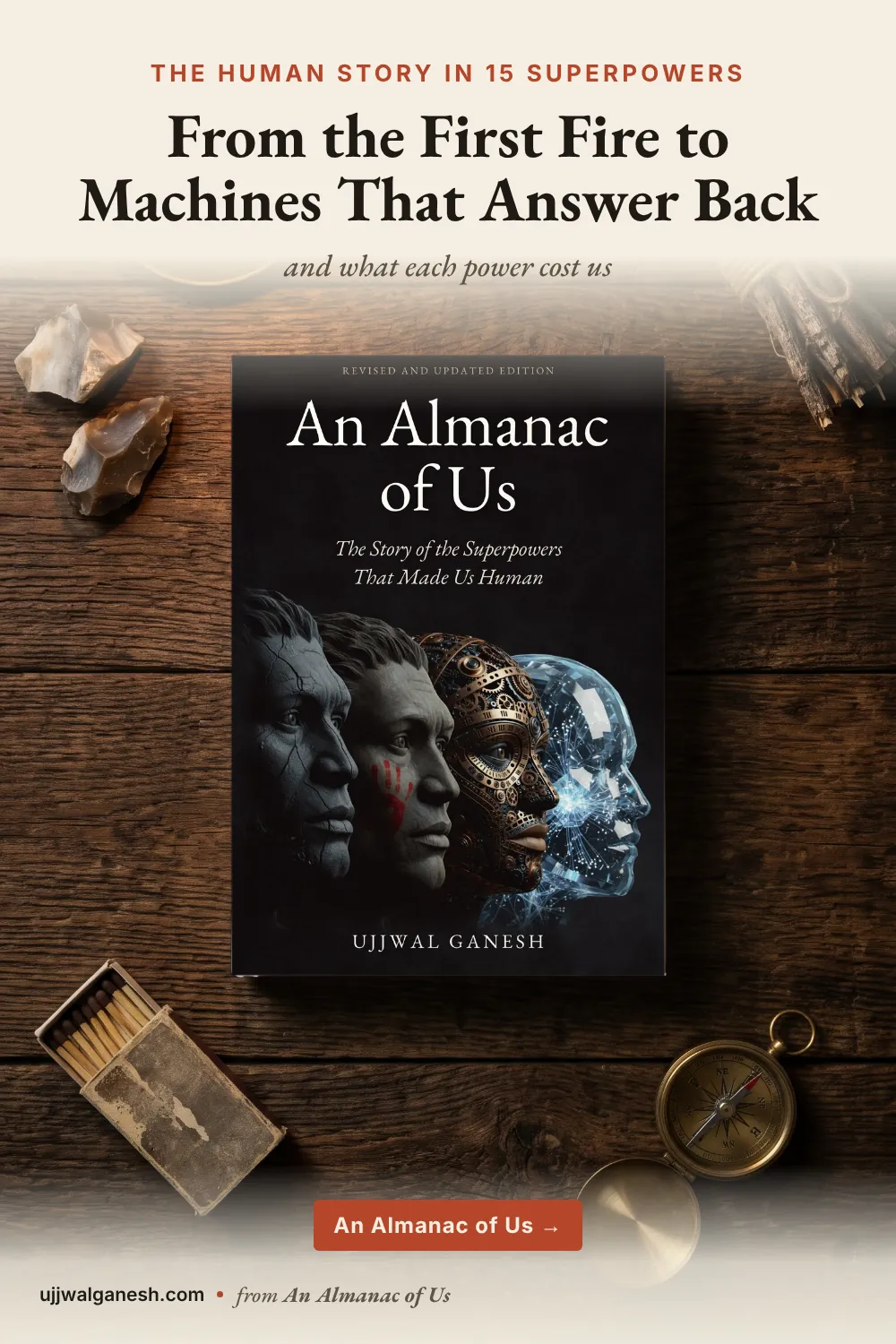
These facts come from the first chapter of my book An Almanac of Us: The Story of the Superpowers That Made Us Human. It tells the human story as fifteen borrowed superpowers, from the first kept fires to machines that answer back, and asks what each one cost us as well as what it gave. Every chapter keeps the open questions in, like the cooking debate above, rather than smoothing them over.
I wrote this book. Links to Amazon are paid links: I earn a small commission on qualifying purchases, on top of my author royalty.
Get it on Amazon: Hardcover (paid link) · Paperback (paid link) · Kindle (paid link)
Readers in India: Kindle on Amazon.in (paid link) · More about the book on its book page.
Frequently asked questions
When did humans first use fire?
The first clear evidence of fire in places where our ancestors lived is about a million years old, at Wonderwerk Cave in South Africa, and a 2026 study suggests it may go back further there. Regular fire use became common only between about 400,000 and 300,000 years ago. Earlier fire use is hard to prove and still debated.
Who discovered fire?
No single person or species “discovered” fire. Wildfires have always existed. Our ancestors first learned to live alongside it, then to keep it alive, and much later to make it. The earliest fire-keepers were probably Homo erectus or close relatives; the oldest known fire-makers were probably early Neanderthals.
How did fire change human evolution?
Fire gave our ancestors warmth, safety at night, cooked food and a new time of day, the evening, for talk and stories. Many scientists think cooking helped shape our small teeth, short gut and large brain, but the timing is still argued over.
Did Neanderthals make fire?
Yes, at least some did. The oldest direct evidence of fire-making, about 415,000 years old at Barnham in England, is thought to have been left by early Neanderthals.
Illustrations created with AI (Google Gemini) and edited by the author; the book cover is the real cover. The facts in this post come from Chapter 1 of An Almanac of Us, “When We Swallowed the Sun”, and were checked against the original studies, including: Pruetz & LaDuke 2010 (Fongoli chimpanzees); Bonta et al. 2017 (firehawks); Brain 1970 (Swartkrans); Weiner et al. 1998 (Zhoukoudian); Berna et al. 2012 (Wonderwerk); Goren-Inbar et al. 2004 (Gesher Benot Ya’aqov); Davis et al. 2025 (Barnham); Evenepoel et al. 1998 (egg protein); Aiello & Wheeler 1995; Organ et al. 2011 (feeding time); Koebnick et al. 1999 (raw-food diets); Zink & Lieberman 2016 (food processing); Wiessner 2014 (firelight talk); WHO household air pollution fact sheet.