How to Stop Overthinking: 7 Thinking Traps That Keep Your Mind Looping
Overthinking feels like solving a problem. Usually it is one of a few predictable thinking traps on repeat. Here are seven, with a one-line test for each and a 10-minute reset for nights your mind won't stop.

I once spent three days on a single email. It was a pitch to a client who could change the direction of my work, so I rewrote every sentence, agonised over the subject line and scheduled it for the “perfect” time. Then my roommate walked past, asked why I was still sitting on it, and hit send.
I panicked. The client replied within an hour. They loved it, and we started working together the following week.
Three days of “thinking it through” had not made the email better. It had only kept it in my outbox. That is the trick overthinking plays: it feels like work. Replaying a conversation feels like learning from it. Running through what-ifs feels like preparing. Most of the time, the mind is not solving anything. It is circling.
While writing The Art of De-Illusion, I noticed that these loops are rarely random. They tend to run on a handful of predictable thinking errors, which psychologists call cognitive biases. Once you can name the one at work, you get what the book calls “the gap”: a small space between the thought and your reaction to it. I won’t promise the thoughts disappear. The book doesn’t either: “This book will not make the illusions disappear.” What you get is faster noticing, and a shorter loop.

A note before we start: this post is about everyday overthinking, the kind almost everyone knows. It is not medical advice. If your thoughts feel out of control, see When it’s more than overthinking near the end.
Why “just stop thinking about it” backfires
In 1987 the psychologist Daniel Wegner asked people to think about anything they liked, except a white bear. They couldn’t do it. The bear kept coming back, and when people were later allowed to think about it, they thought about it even more than people who had never tried to push it away.
His team found something else that matters here. People who were given one specific thing to think about instead were less likely to get stuck on the bear afterwards.
So the aim is not to force a thought out. It is to give your mind a different, specific job. In this post, that job is simple: name the trap, then run its test.
First, find out which loop you’re in
Most overthinking falls into one of three loops. Each has its own traps.
| If your mind keeps… | It sounds like… | The traps to check |
|---|---|---|
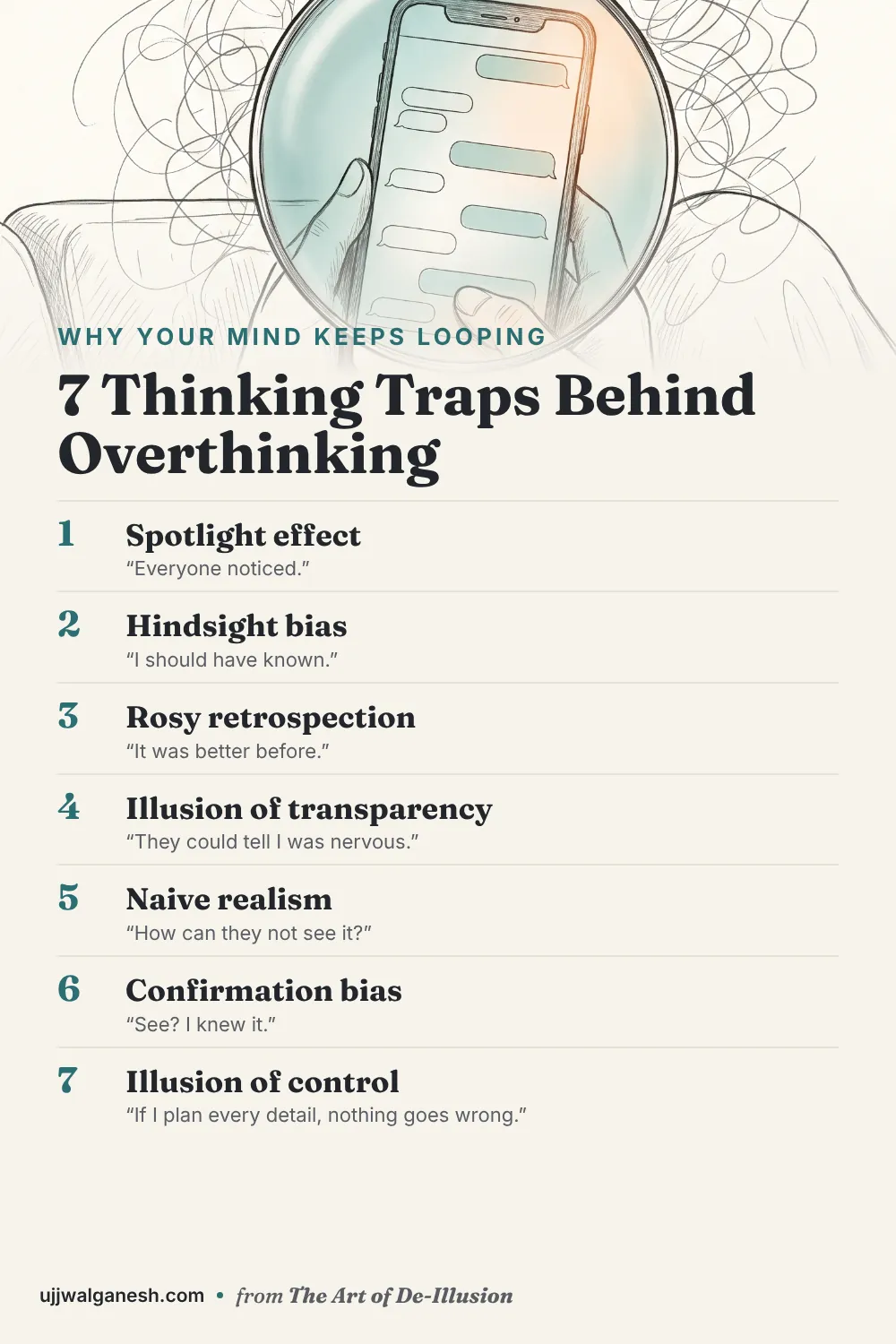
| Replaying the past | “Everyone noticed.” “I should have known.” “It was better before.” | 1. Spotlight effect · 2. Hindsight bias · 3. Rosy retrospection |
| Reading other people’s minds | “They could tell I was nervous.” “How can they not see it?” | 4. Illusion of transparency · 5. Naive realism |
| Running what-ifs about the future | “See? I knew it.” “If I plan every detail, nothing will go wrong.” | 6. Confirmation bias · 7. Illusion of control |
In the book, the same idea is one question: “Is my Mirror, Portrait, or Map distorted right now?” The Mirror is how you see yourself, the Portrait is how you see other people, and the Map is how you understand the world.
The replay loop
1. “Everyone noticed.” The spotlight effect
When I was nine, I gave an Independence Day speech in front of the whole school. Near the end, my mind went blank. My face burned and the only thought in my head was: everyone sees this, and they will remember it forever. I walked off the stage and spent the rest of the programme replaying the disaster.
Then they announced the prizes. I had won. The moment that felt like a public humiliation had barely registered with anyone else.
This is the spotlight effect: we overestimate how much other people notice about us. In a well-known set of Cornell studies, students who walked into a room wearing an embarrassing T-shirt guessed that roughly twice as many people had noticed it as actually had (Gilovich, Medvec and Savitsky, 2000). Everyone is walking around with their own spotlight pointed at themselves.
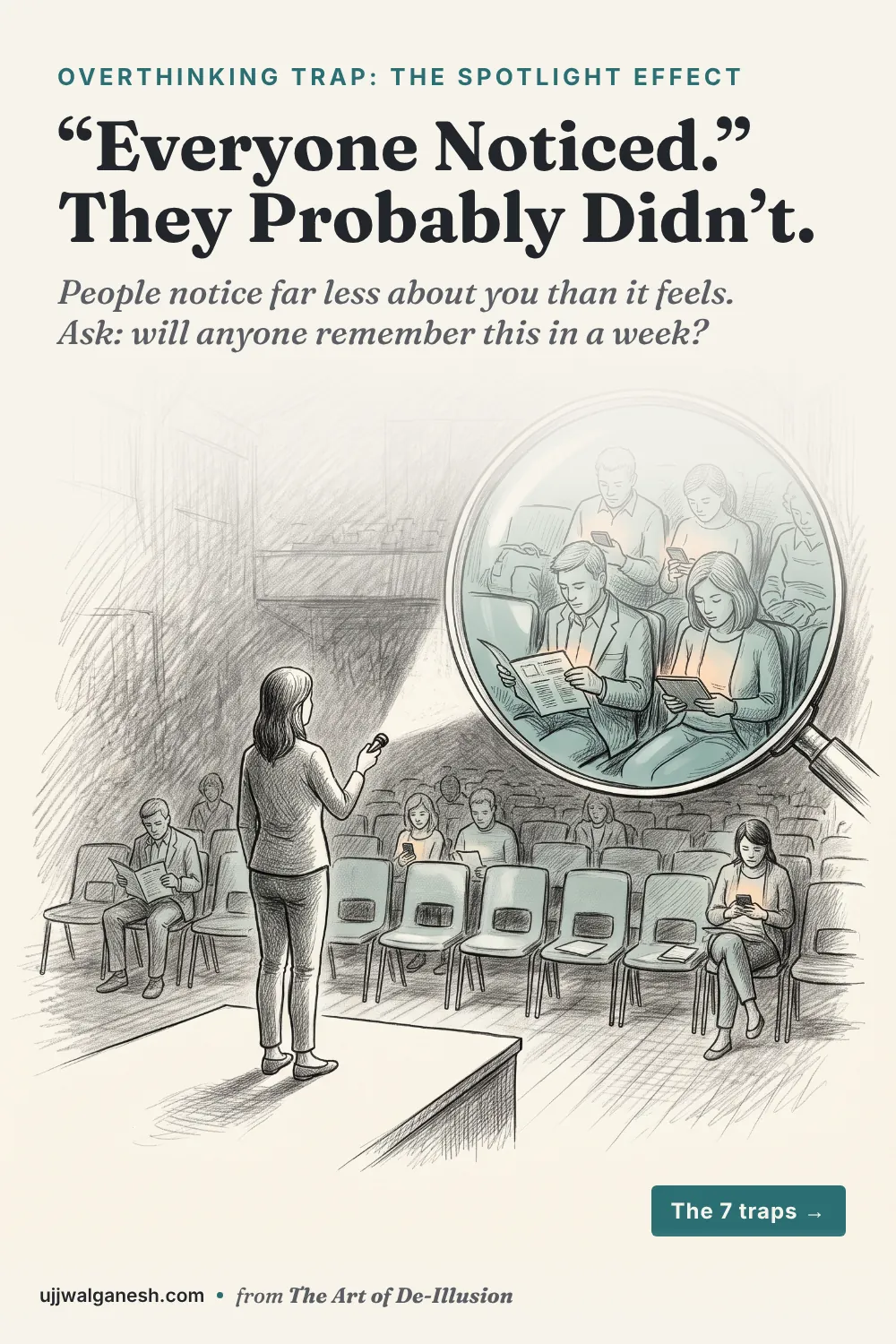
The test: Think of something embarrassing you did recently. Now try to recall something embarrassing a friend or colleague did in the same week. Hard? If you can’t remember theirs, why would they remember yours?
The practice: The book’s One Week Test. Ask: “Will anyone remember this in one week?” The answer is almost always no. Not because people don’t care about you, but because they are busy replaying their own moments.
2. “I should have known.” Hindsight bias
Once you know how something ended, the beginning looks different. The warning signs look obvious, the right choice looks clear, and your past self looks careless. This is hindsight bias. In a classic 1975 study, Baruch Fischhoff showed that people who were told how a past event turned out rated that outcome as more likely than people who weren’t told, and didn’t realise the knowledge had changed their judgement.
The loop sounds like: Why didn’t I see it? It was right there. But the clarity you feel now was borrowed from the future. It did not exist when you made the decision.
The test: Ask, “What did I actually know at the time?” Not what you know now. Write down only the facts you had then. If you can’t separate then-knowledge from now-knowledge, hindsight is doing the talking.
The practice: The Pre-Decision Journal. Before an important decision, write what you know, what you don’t know, and why you’re choosing what you’re choosing. If it goes badly, you will have a fair record of the person who made it.
3. “It was better before.” Rosy retrospection
Memory edits. Over time it softens the hard parts of an experience and brightens the good ones. Researchers who followed students on a three-week bicycle trip in California found that they rated it less positively while they were on it than they did looking back afterwards (Mitchell and colleagues, 1997).
That is harmless until you start comparing a polished memory with your raw present. The old job, the old city, the “simpler” years: the loop says I should never have left, and the present loses an unfair contest.
The test: Think of the period you miss. Now recall one specific bad day from it: a day you were bored, anxious or fed up. If you can’t find one, your memory has been heavily edited.
The practice: The Snapshot Journal. Jot down a few lines about ordinary days now, frustrations included. In a few years, it will stop you comparing today with a past that never quite existed.
The mind-reading loop
4. “They could tell I was nervous.” The illusion of transparency
You know exactly how nervous you felt in that meeting, so it feels as if everyone else knew too. They didn’t. Psychologists call this the illusion of transparency: we overestimate how much of our inner state shows on the outside.
The encouraging part is that knowing this helps. In one study, students who were told about the illusion of transparency before giving a speech felt less nervous, and observers rated their speeches as better than those of students who weren’t told (Savitsky and Gilovich, 2003). You have just been told.

The test: After the conversation you keep replaying, ask: “How much of what I was thinking and feeling did I actually say out loud?” If the answer is “not much”, the other person knows far less about your state than you assume.
The practice: Say it out loud. If something matters, say it in words. If you think your message came across as cold, you can simply ask. Communication needs actual words, not assumed broadcasts.
5. “How can they not see it?” Naive realism
After a disagreement, the replay often sounds like a courtroom: I was so clear. The facts are obvious. Why are they being so difficult? Psychologists call the assumption underneath it naive realism: the belief that you see the world as it really is, so anyone who disagrees must be uninformed, irrational or biased.
That belief keeps the argument running in your head long after it has ended, because you are arguing with a cartoon of the other person, not with them.
The test: Can you describe their view in a way they would recognise and accept? If not, you haven’t seen them yet.
The practice: The Steel Man. Write the strongest version of their side in three sentences, the version they would actually make. Often the loop quietens, because there is finally something new to think about.
The what-if loop
6. “See? I knew it.” Confirmation bias
“Your brain is not a scientist. It is a lawyer.” The Art of De-Illusion
A scientist looks at the evidence and asks what it shows. A lawyer starts with a verdict and collects evidence for it. When you are worried, your mind tends to act as a lawyer for the worst-case story. A short reply from a friend becomes Exhibit A, so you scroll back through old messages to collect proof that something is wrong, while the twenty warm ones go unread. I wrote about how fast the mind builds these stories in How to Spot the Fictions Your Mind Tells You.
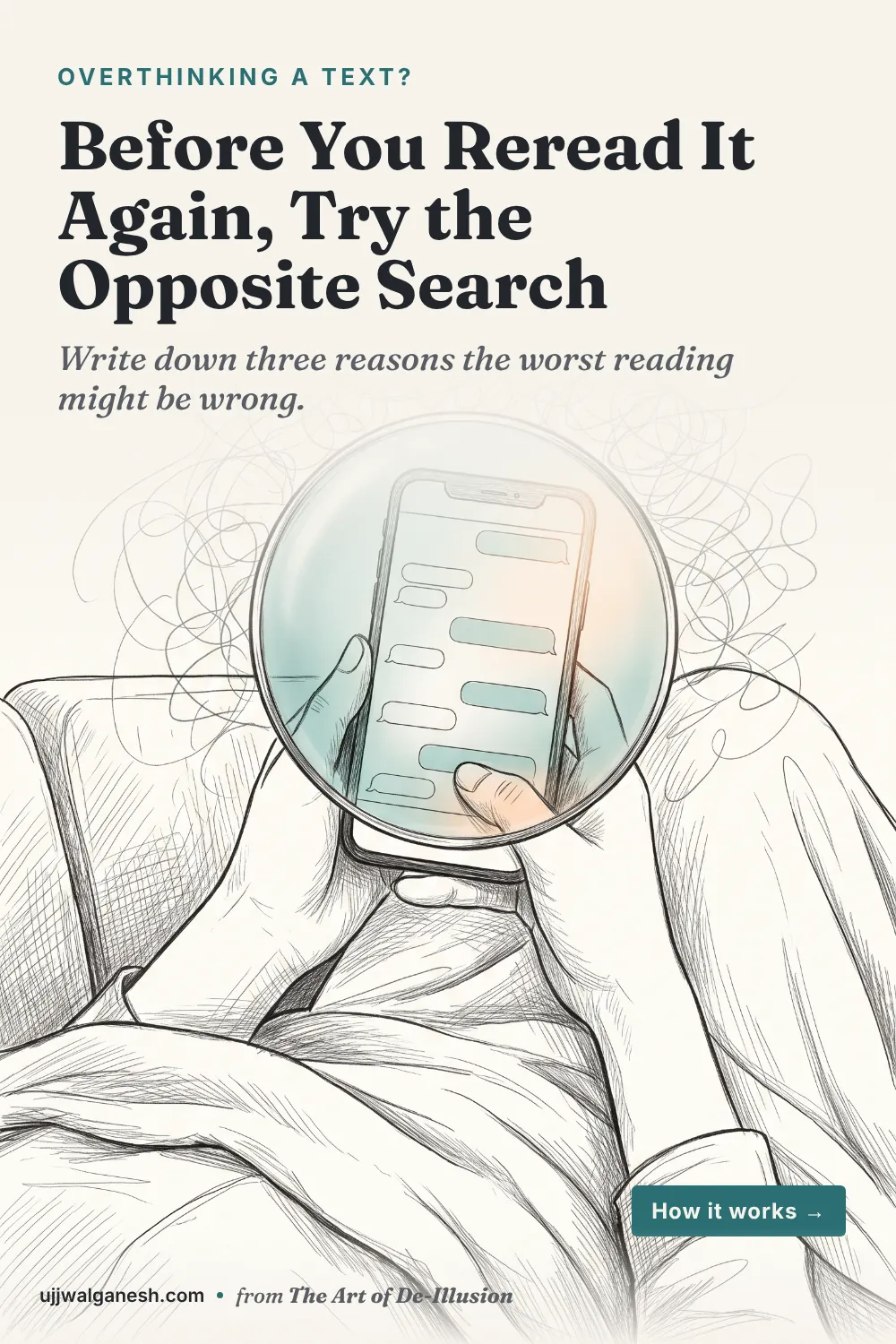
The test: Ask, “When did I last look for evidence that I might be wrong about this?” If the honest answer is never, the lawyer is in charge.
The practice: The Opposite Search. Before you reread the message or replay the scene again, write down three pieces of evidence against the worst reading. It feels unnatural. That is usually a sign it’s working.
7. “If I plan every detail, nothing will go wrong.” The illusion of control
This was my three-day email. Rewriting, rescheduling and running scenarios felt like control. The outcome was never in my hands: it depended on a client I had never met. The illusion of control is our tendency to believe we steer far more than we do, and it fuels the what-if loop because there is always one more scenario to prepare for.
The test: List everything that will decide how this goes. Now mark the items you can actually influence. If the list is shorter than you expected, you have found the loop’s fuel.
The practice: The book’s Control Audit. Split the situation into three columns: what you control, what you can influence, and what you can’t control at all. Put your energy into the first two. Write the third column down, then let it sit on the page instead of in your head.

If your overthinking mostly shows up as never starting, that is a slightly different pattern. My 10-minute Ugly Step method is built for that one.
A 10-minute reset for when your mind won’t stop at night
This is the routine I use, built from the tests above. It works on paper, not in your head.
- Write the loop in one sentence. Not the whole story, just the line that keeps repeating: “I think I upset her in the meeting.”
- Name the loop. Is it about the past, about what someone else is thinking, or about the future?
- Name the trap. Use the table above. Most loops match one or two.
- Run its test, in writing. One question, honestly answered.
- Talk to yourself by name. Ask the question as if you were coaching a friend: “Priya, what did you actually say out loud?” In a series of studies, people who used their own name or “you” in their self-talk before a stressful speech felt less distressed, and observers rated their performance as better (Kross and colleagues, 2014).
- Give your mind a specific next job. Write one small action for tomorrow, or one thing you’ll check in daylight. Then close the notebook. Remember the white bear: “stop thinking” fails, “think about this instead” helps.
It won’t make the thought vanish. It usually makes the loop shorter, and that is often enough to fall asleep.

Quick reference: 7 traps and their tests
| Loop | It sounds like | The trap | Ask yourself |
|---|---|---|---|
| Past | “Everyone noticed.” | Spotlight effect | Will anyone remember this in one week? |
| Past | “I should have known.” | Hindsight bias | What did I actually know at the time? |
| Past | “It was better before.” | Rosy retrospection | Can I recall one bad day from back then? |
| Other people | “They could tell I was nervous.” | Illusion of transparency | How much did I actually say out loud? |
| Other people | “How can they not see it?” | Naive realism | Can I state their view so they’d agree with it? |
| Future | “See? I knew it.” | Confirmation bias | What is the evidence against the worst reading? |
| Future | “If I plan everything, nothing will go wrong.” | Illusion of control | Which parts can I actually control or influence? |
When it’s more than overthinking
Everyone’s mind loops sometimes. But if looping thoughts come most days for weeks, keep you awake night after night, come with panic or a low mood that won’t lift, or include thoughts of harming yourself, please talk to a doctor or a mental health professional. You don’t have to sort it out alone. In India, you can call Tele MANAS on 14416 (free, 24 hours). In the US, call or text 988. Elsewhere, contact your local emergency number or a doctor. If anxious thoughts are part of your life, you may also like You Are Not Your Anxious Thoughts.
Go deeper: The Art of De-Illusion

The seven traps in this post come from my book The Art of De-Illusion: How to Stop Your Mind from Lying to You and See the World as It Is. It is a field guide to 52 thinking errors, sorted into three lenses: the Mirror (how you see yourself), the Portrait (how you see other people) and the Map (how you understand the world). Each chapter ends with a one-line test and a practice, like the ones above. It won’t make the illusions disappear. It helps you notice them while they’re happening.
I wrote this book. Links to Amazon are paid links: I earn a small commission on qualifying purchases, on top of my author royalty.
Get it on Amazon: Kindle (paid link) · Paperback (paid link) · Hardcover (paid link)
Readers in India: Kindle on Amazon.in (paid link) · More about the book on its book page.
Frequently asked questions
Why do I overthink more at night?
During the day, tasks and people compete for your attention. At night, in a quiet room, the loop has the stage to itself. That is why the reset above happens on paper: it gives your mind a specific job instead of an open question.
Is overthinking the same as anxiety?
Not exactly. Overthinking is a habit of repetitive thinking that almost everyone experiences at times. Psychologists study it as rumination (going over the past) and worry (going over the future), and it can be part of anxiety or depression. If it is constant or distressing, a professional can help you work out what is going on.
How do I stop overthinking a text or a conversation?
Check two traps. The illusion of transparency: the other person probably read far less into it than you think. Confirmation bias: write down three pieces of evidence against the worst reading before you reread anything. If it still matters, say so or ask. One honest question usually ends a loop faster than ten rereads.
What’s the difference between cognitive biases and cognitive distortions?
Cognitive biases are predictable errors in how all human minds process information, studied by psychologists and behavioural economists. Cognitive distortions are a term from cognitive behavioural therapy (CBT) for unhelpful thinking patterns, such as catastrophising, that often come with distress. They overlap, but they come from different traditions. This post and the book focus on biases.
Illustrations created with AI (Google Gemini) and edited by the author. The tests and practices in this post are adapted from The Art of De-Illusion (2nd edition), which is an educational book, not medical or psychological advice.
Sources: Wegner, D. M., Schneider, D. J., Carter, S. R. & White, T. L. (1987), “Paradoxical effects of thought suppression”, Journal of Personality and Social Psychology 53(1); Gilovich, T., Medvec, V. H. & Savitsky, K. (2000), “The spotlight effect in social judgment”, Journal of Personality and Social Psychology 78(2); Fischhoff, B. (1975), “Hindsight ≠ foresight”, Journal of Experimental Psychology: Human Perception and Performance 1(3); Mitchell, T. R., Thompson, L., Peterson, E. & Cronk, R. (1997), “Temporal adjustments in the evaluation of events: the ‘rosy view'”, Journal of Experimental Social Psychology 33(4); Savitsky, K. & Gilovich, T. (2003), “The illusion of transparency and the alleviation of speech anxiety”, Journal of Experimental Social Psychology 39(6); Kross, E. and colleagues (2014), “Self-talk as a regulatory mechanism: how you do it matters”, Journal of Personality and Social Psychology 106(2).