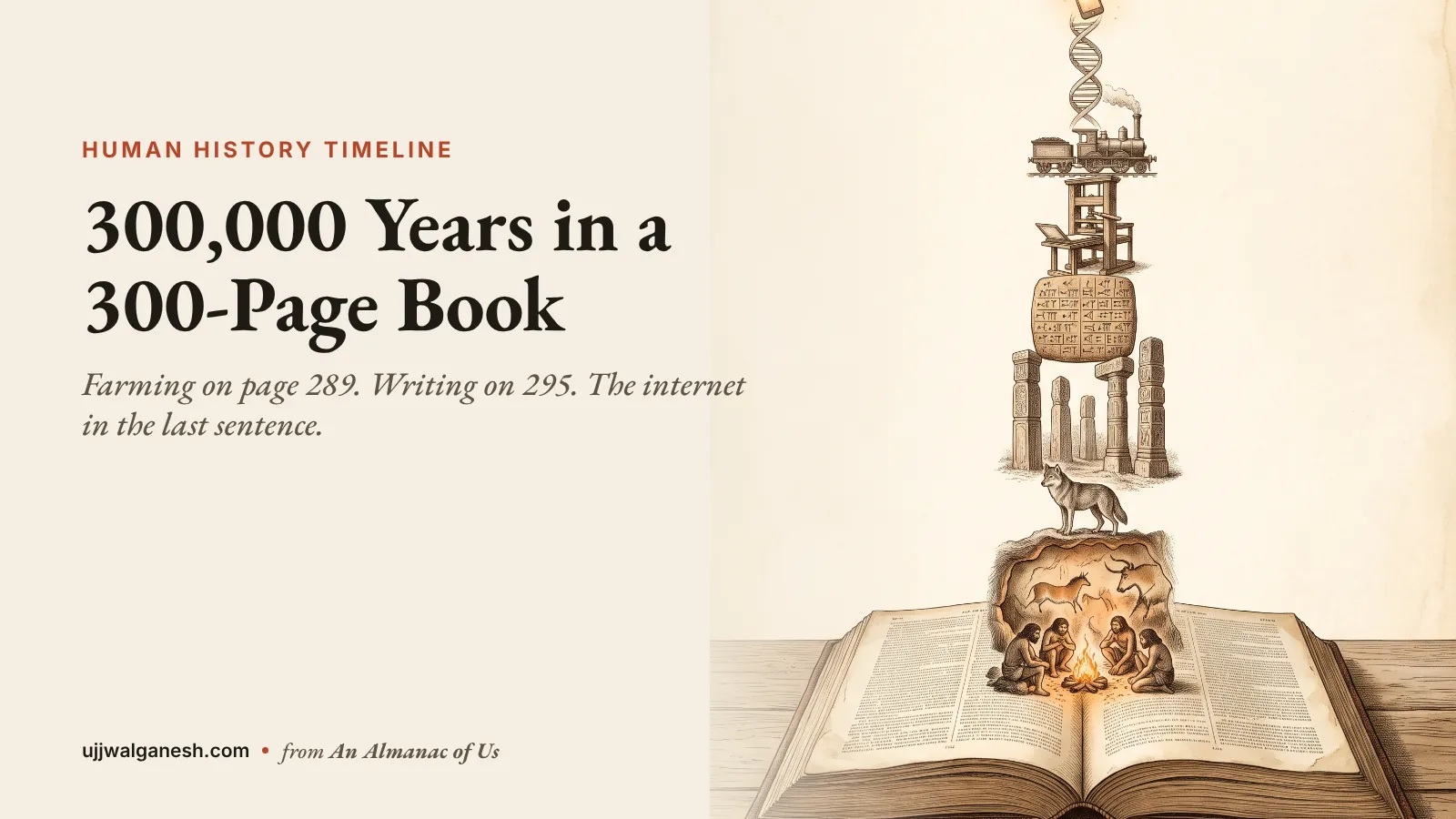
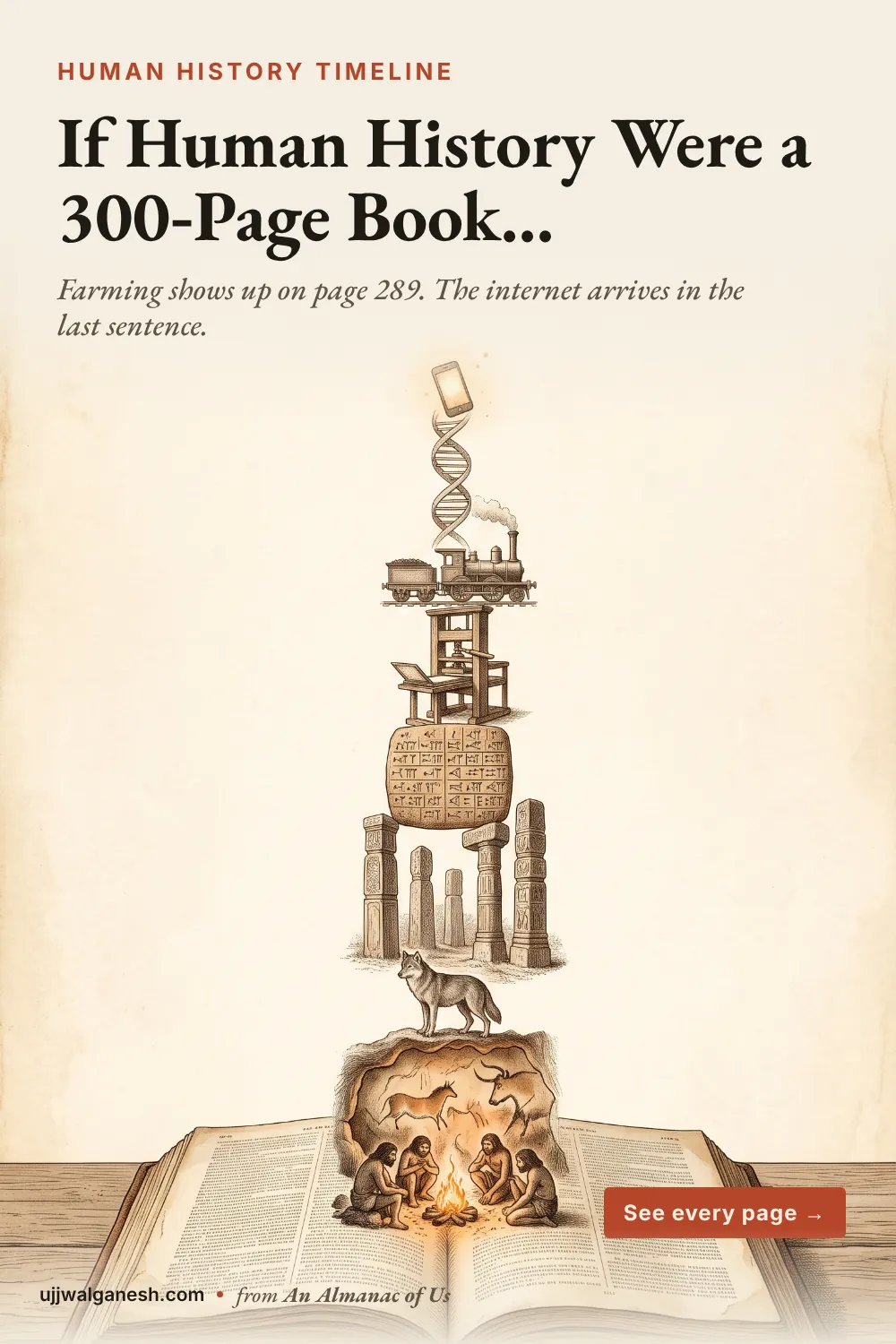
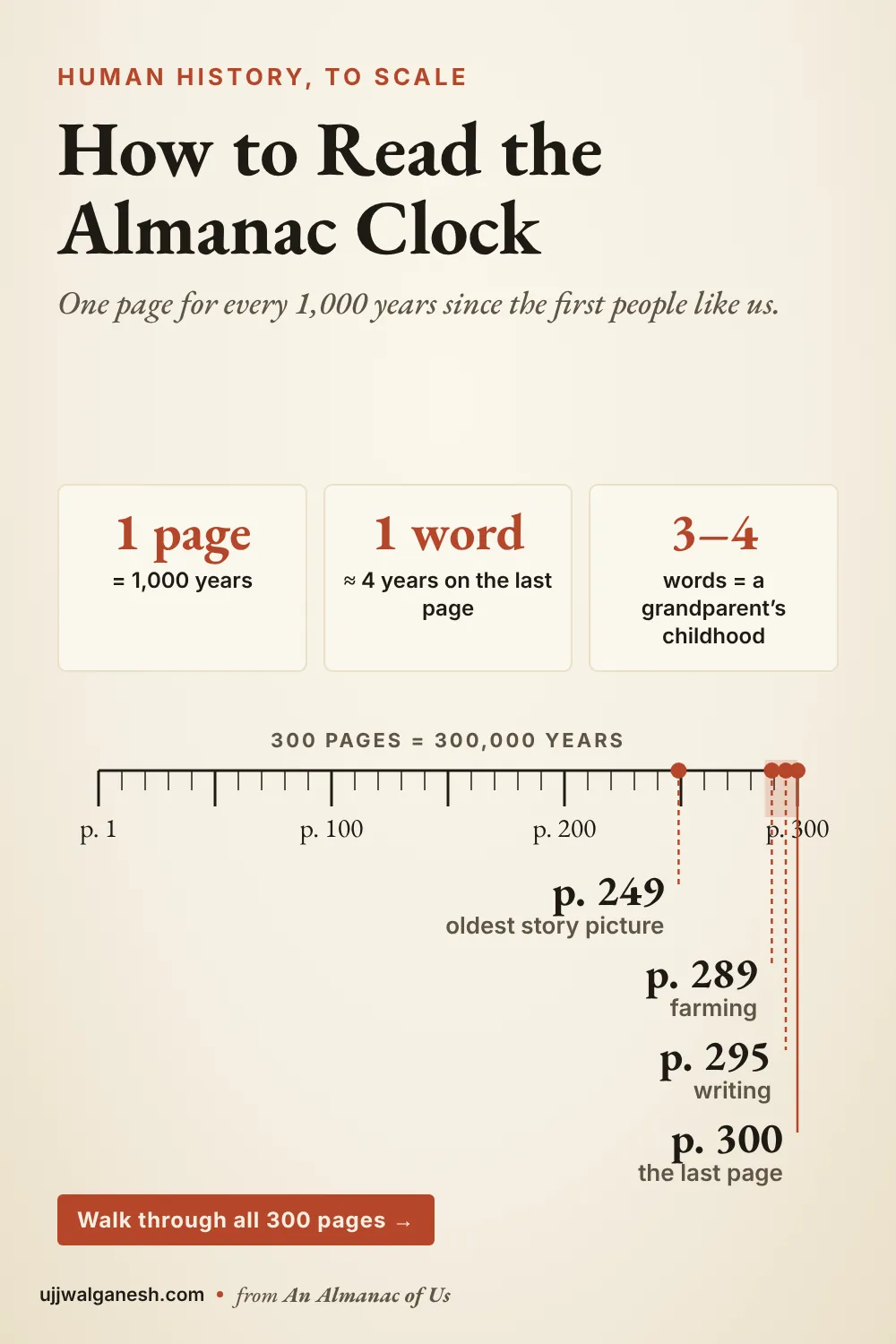
Here is a human history timeline you won’t forget. Give every thousand years since the first people like us a single page, and you get a book of about 300 pages. Farming doesn’t show up until page 289. Writing appears on page 295. Everything from the printing press to the phone in your hand is crammed onto the last page, and the internet arrives in the last sentence.
I call it the Almanac Clock, and it is the spine of my book, An Almanac of Us: The Story of the Superpowers That Made Us Human. Below, we walk through it page by page, from the first kept fires to the final word, which is still being written.
In this post:
- How this human history timeline works
- Before page one: we learned to keep fire
- Page 249: someone painted a story
- Pages 271–286: the wolf at the doorstep
- Page 289: the first fields
- Pages 295–299: writing, law, money and zero
- The last page: from the printing press to AI
- Why every power came sooner
- The page after the last
- Frequently asked questions
How this human history timeline works
For centuries, families kept an almanac: a book for the year ahead, with a calendar, the phases of the moon, the times of sunrise, advice on when to plant and a few sayings to live by. Many families in India still look up auspicious days in a panchang, the Hindu almanac.
Now imagine an almanac whose year is 300,000 years long. That is roughly how long our species, Homo sapiens, has existed: the oldest known fossils of people like us, found at Jebel Irhoud in Morocco, are about 300,000 years old. Give each thousand years one page, and the scale does the rest:
- One page = 1,000 years.
- On the last page, one word ≈ 4 years (a page holds about 250 words).
- A grandparent’s childhood fits into three or four words.
The trick works because it turns numbers too big to feel into something you can hold. “300,000 years” is an abstraction. A book in which farming shows up eleven pages from the end is not.
Before page one: we learned to keep fire
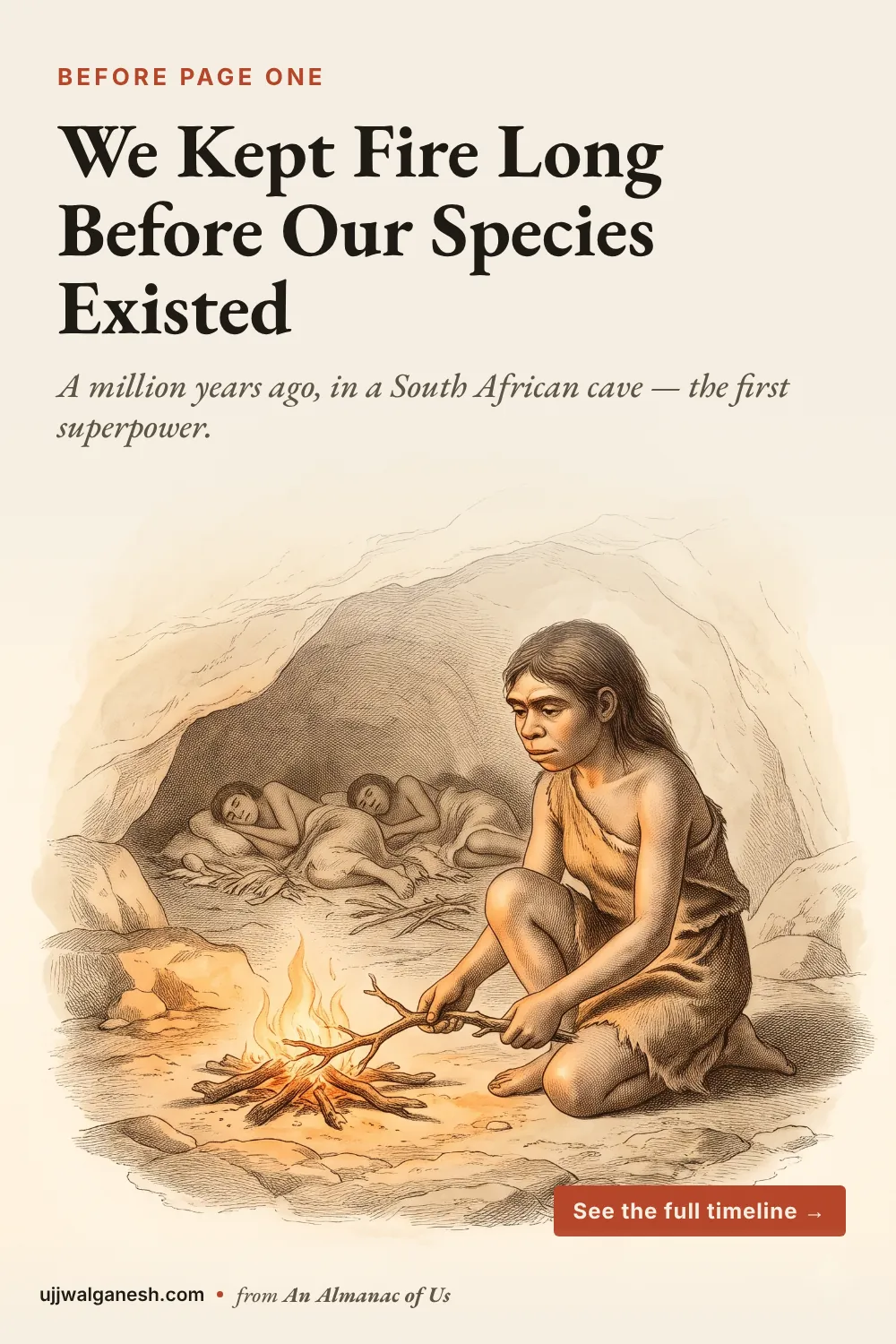
The story starts before the book does. The first clear signs of fire where people lived are about a million years old. At Wonderwerk Cave, in South Africa’s Northern Cape, archaeologists found ash and burned bone some thirty meters inside the cave, too deep for a bush fire on the hillside to have blown them in. Someone had brought fire inside. The people who kept it were not yet our species.
Fire was the first job our ancestors handed to something outside their bodies. It worked like a stomach outside the body: in one study, people took up about nine-tenths of the protein in cooked eggs, but only about half from raw ones. It also gave us something no other animal has: an evening. Around the fire, with nothing to hunt or gather in the dark, people talked, settled quarrels and told stories.
On the Almanac Clock, all of this happens hundreds of pages before page one.
Page 249: someone painted a story
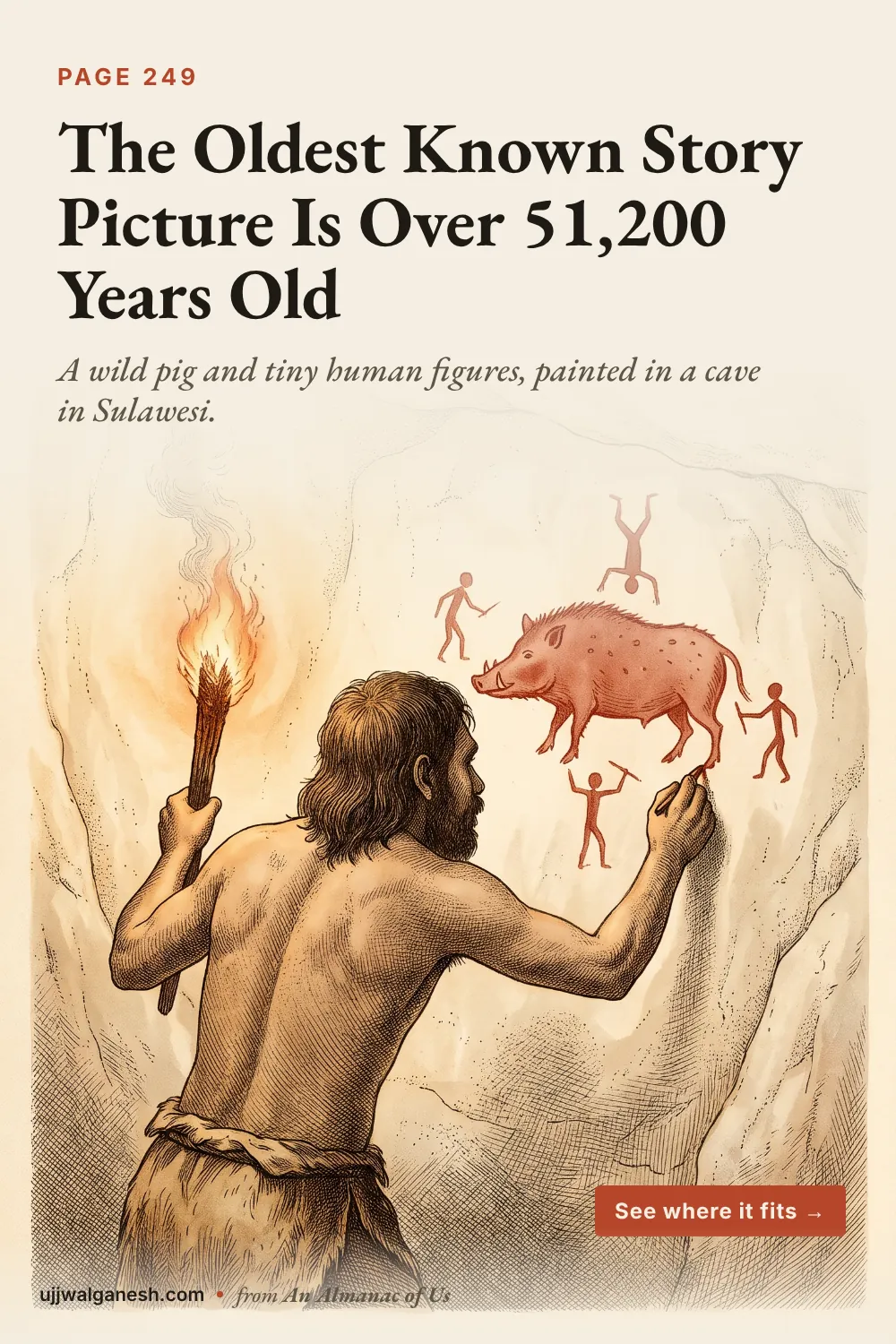
For most of the first 250 pages, almost nothing survives except stone tools, bones and the ashes of old fires. Then, on page 249, a painter in a limestone cave on the Indonesian island of Sulawesi left a scene in red ochre: a wild pig with three small human-like figures around it. In 2024, scientists dated mineral crusts that had formed over the paint to at least 51,200 years ago. It is the oldest known picture that tells a story.
A hand stencil on a wall says “someone was here.” A pig with three figures around it says “something happened.” To make it, the painter needed a mind that could hold a scene that was not in front of it, and an audience that could look at a few red lines and see the same scene. That shared imagination, the book argues, is the superpower that let strangers trust one another.
Pages 271–286: the wolf at the doorstep
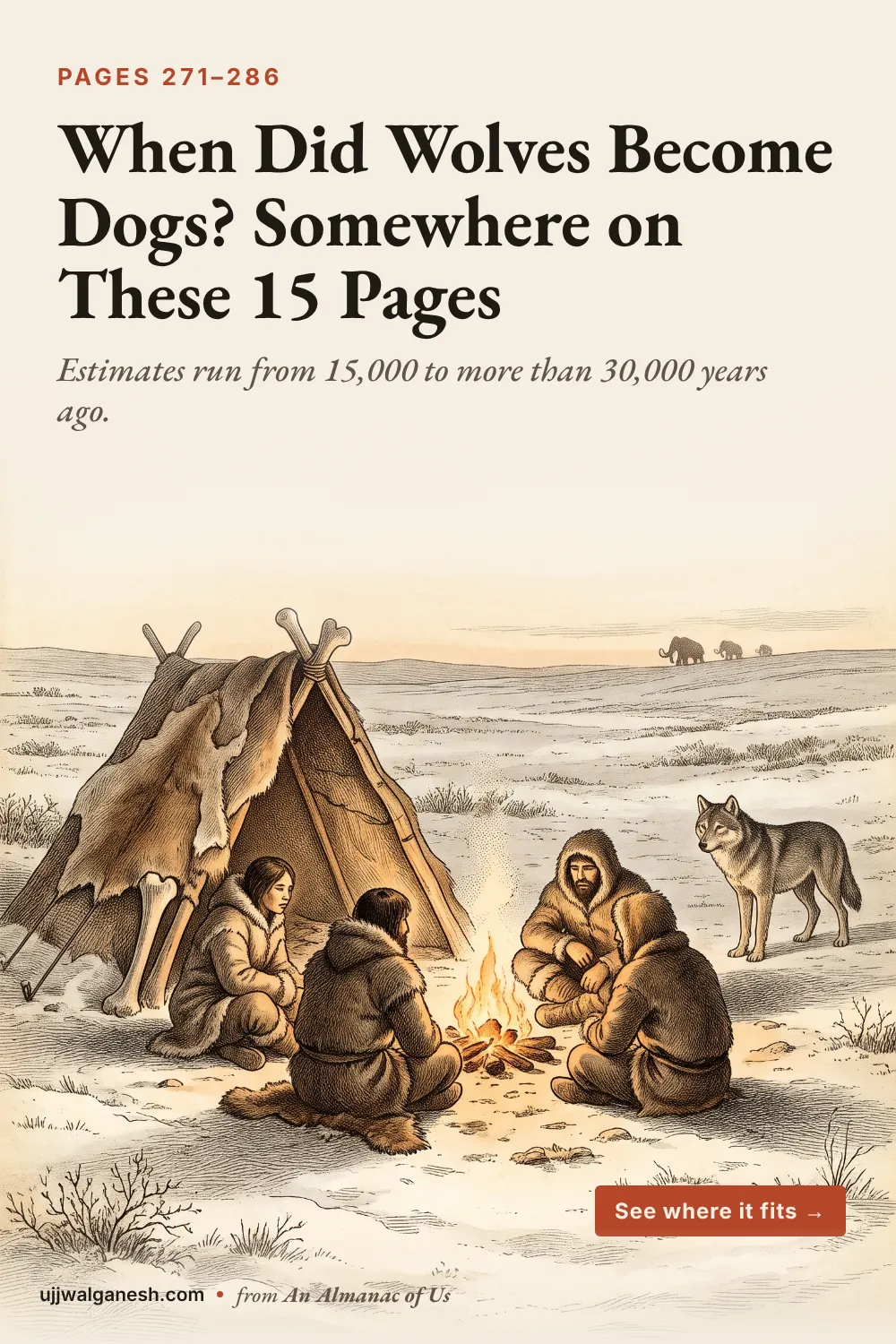
Somewhere between page 271 and page 286 (scientists still argue over the date), some wolves began living alongside people and slowly became dogs. Estimates run from about 15,000 to more than 30,000 years ago. One strong recent proposal points to Siberia around 23,000 years ago, in the coldest part of the last ice age.
What is not in doubt is the bond. In a grave at Oberkassel, in Germany, about 14,000 years old, two people were buried with a young dog. Its teeth show it had survived months of canine distemper, which means someone nursed it through the illness. The wolf lent us its nose and ears; we gave it a place by the fire. It was the first animal to join us.
Page 289: the first fields
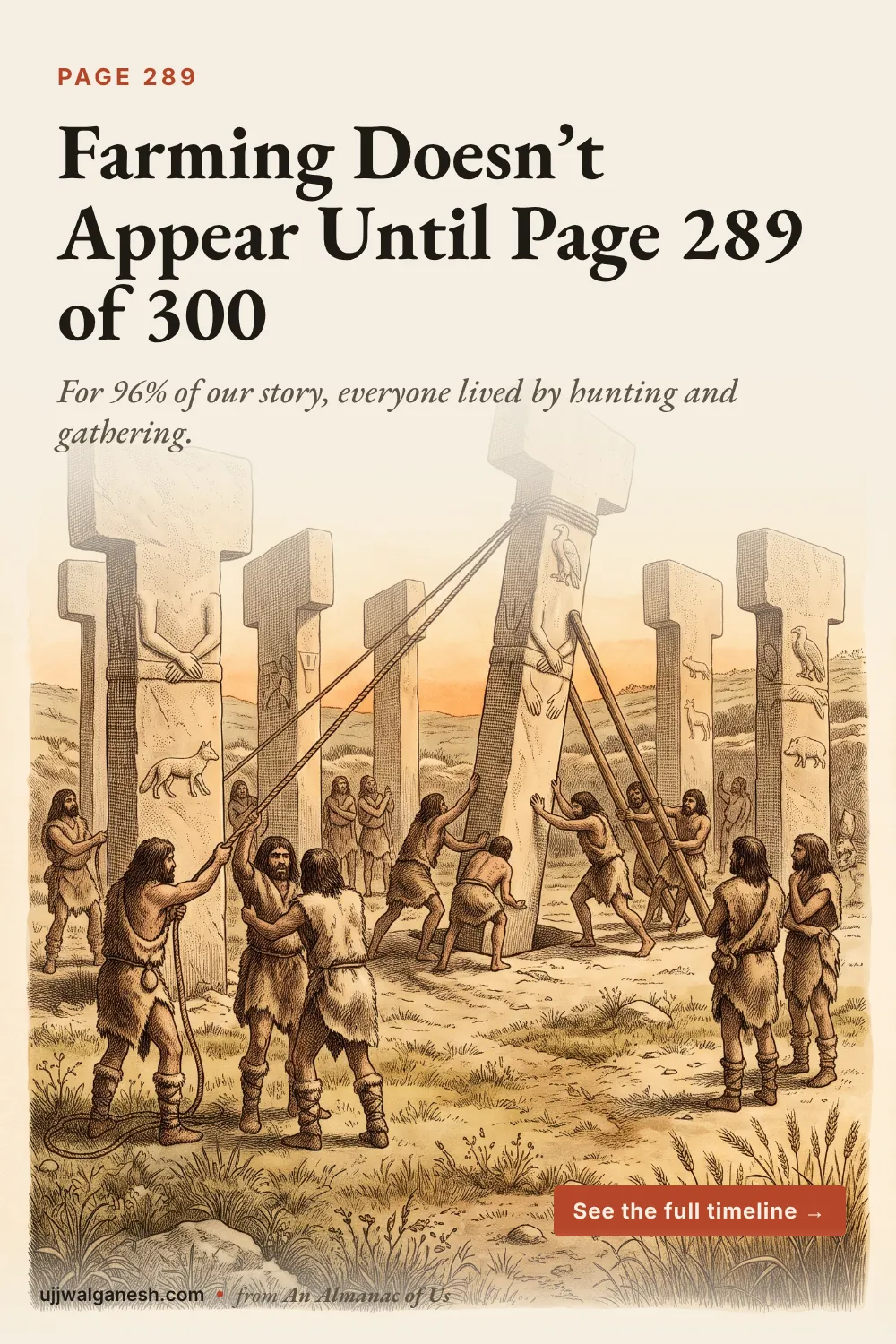
Farming, the change that made villages, cities and empires possible, doesn’t appear until page 289, about eleven pages from the end. For roughly 96% of our species’ story, everyone lived by hunting and gathering.
Even so, monuments came first in some places. At Göbekli Tepe, in south-eastern Türkiye, people who had not yet begun to farm raised circles of carved T-shaped pillars about 11,500 years ago, the tallest about five and a half meters high. Farming itself was invented separately in at least eleven regions of the world: wheat and barley in Southwest Asia, rice and millet in China, maize in Mexico, potatoes in the Andes, taro and bananas in New Guinea.
It was a bargain with costs. Early farmers were often shorter and sicker than the foragers before them, and crowded villages bred new diseases. But farming fed far more people, and more people meant more minds.
Pages 295–299: writing, law, money and zero
Then the pages start to fill up fast.
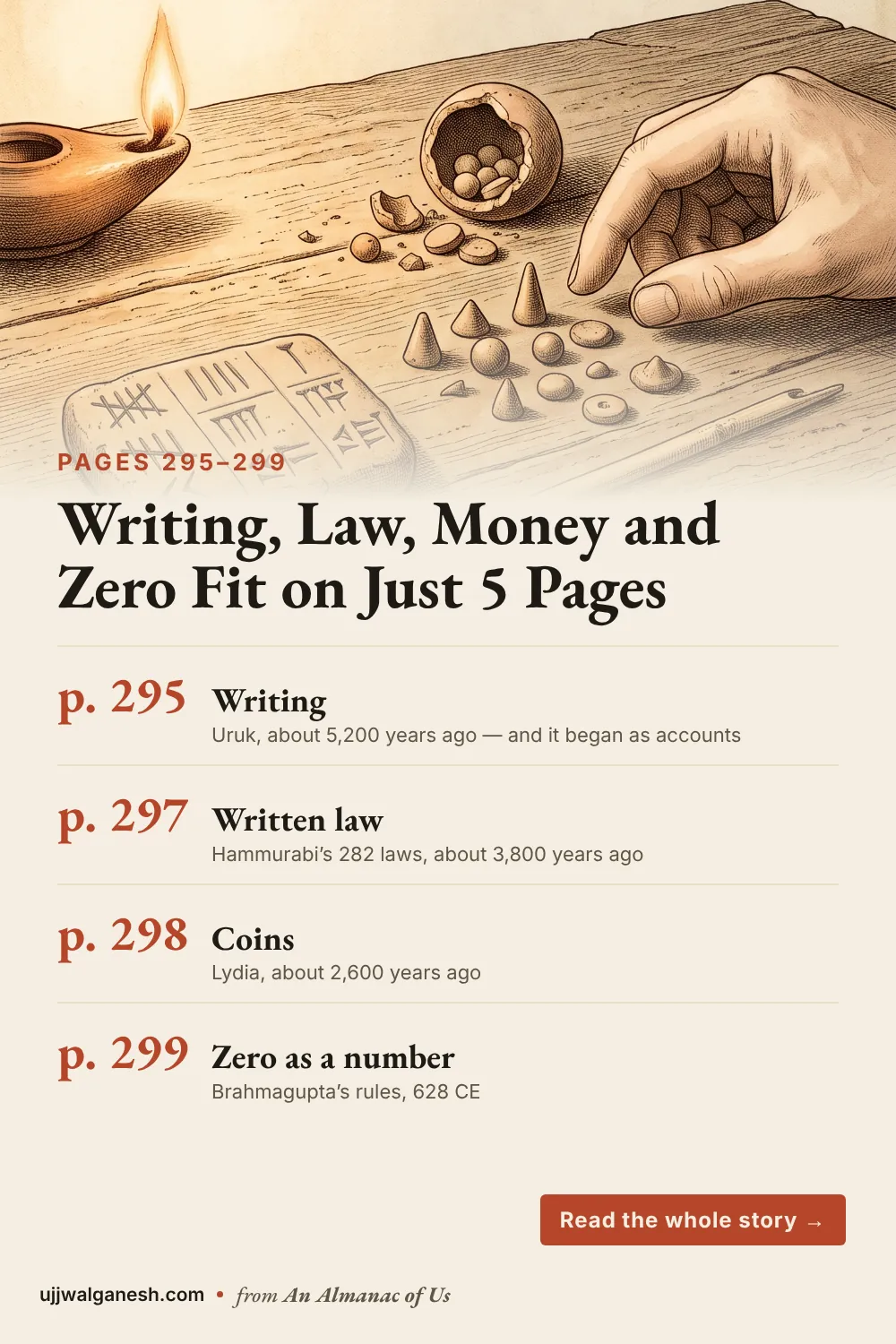
- Page 295 (about 5,200 years ago): writing. The oldest writing, from the Mesopotamian city of Uruk, was not a poem or a prayer. About 85% of the oldest tablets are accounts: grain and beer handed out, animals counted, workers’ rations.
- Page 297 (about 3,800 years ago): written law. Hammurabi of Babylon had 282 laws carved on a black stone, so that any wronged man could have them read aloud.
- Page 298 (about 2,600 years ago): coins. The first coins were struck in Lydia, in today’s Türkiye, from electrum, a natural mix of gold and silver.
- Page 299 (about 1,400 years ago): zero as a number. In 628 CE the Indian astronomer Brahmagupta wrote the first known rules for calculating with zero.
Five pages, and almost everything a city needs is in place: memory outside the head, rules anyone can know, promises strangers will accept, and arithmetic for the accounts.
The last page: from the printing press to AI
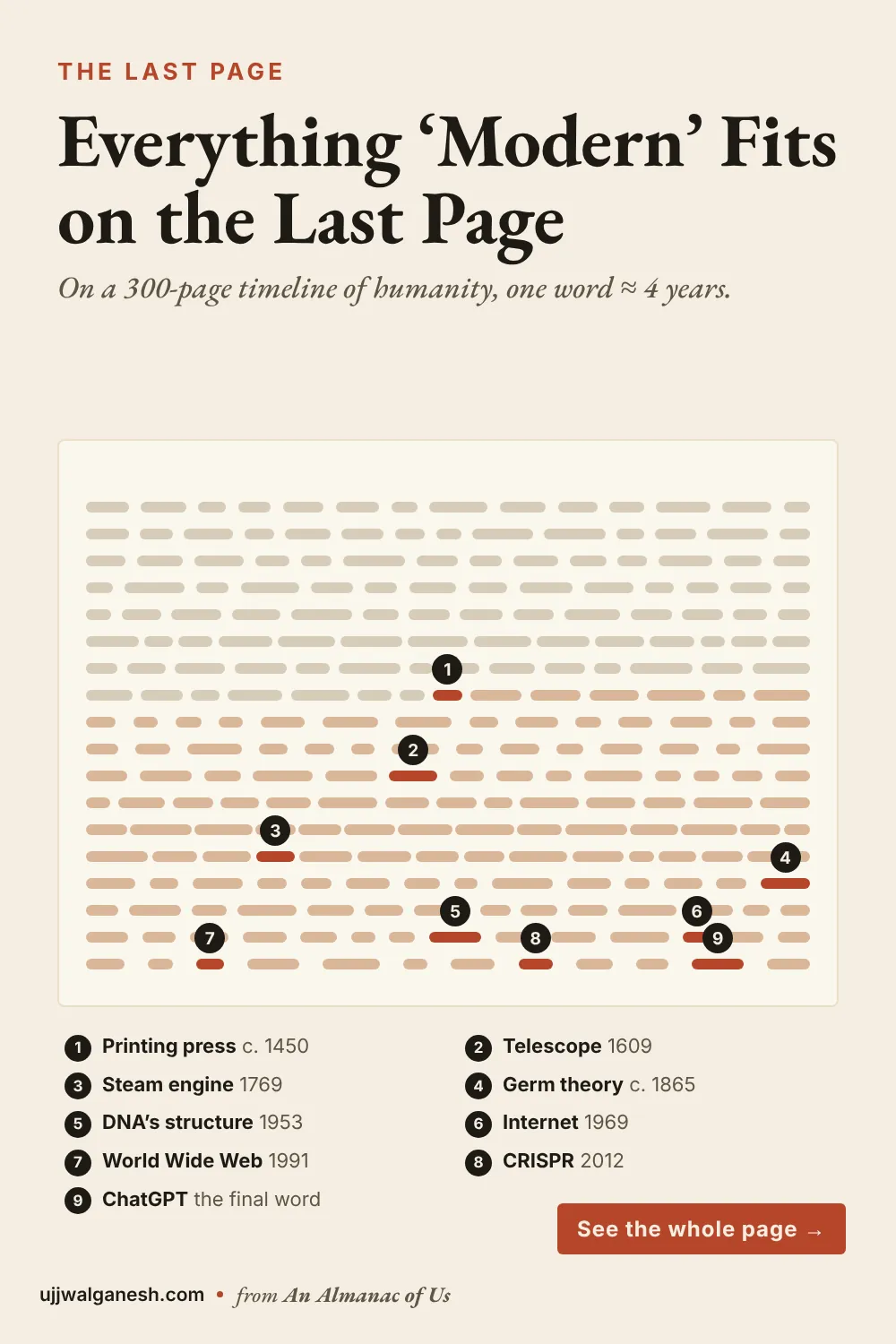
The final page covers the last thousand years. On a page of about 250 words, each word stands for roughly four years. Here is where the modern world lands:
- Printing press (about 1450): about 144 words from the end
- Galileo’s telescope (1609–10): about 104 words from the end
- Watt’s steam engine (1769): about 64 words from the end
- Germ theory (about 1865): about 40 words from the end
- The structure of DNA (1953): about 18 words from the end
- The first internet message (1969): about 14 words from the end
- The World Wide Web (1991): about 9 words from the end
- CRISPR gene editing (2012): about 4 words from the end
- ChatGPT (2022): the final word
Everything you would call “modern” (electric light, antibiotics, flight, the phone in your hand) sits in the last paragraph or so of a 300-page book. Your grandparents’ childhood fits into three or four words.
Why every power came sooner
Look at the spacing and a pattern jumps out. The gaps between big changes shrink from hundreds of pages to single words. The book’s explanation is simple: each new power made the next one easier to find. Stories let more people cooperate. Farming fed more minds. Writing let knowledge outlive the people who had it. Print let an idea reach thousands of readers within a year. More people, better connected and better at storing what they knew, invented faster and spread it further.
The book asks the same three questions of every power: what did we hand over, what did it cost, and why did the next one come sooner? Fire gave us cooked meals and smoke-filled lungs. Farming fed billions and brought new diseases. The network connected us and flooded us with rumours. Every superpower came with terms and conditions, and we clicked “I agree” without reading them.
The page after the last
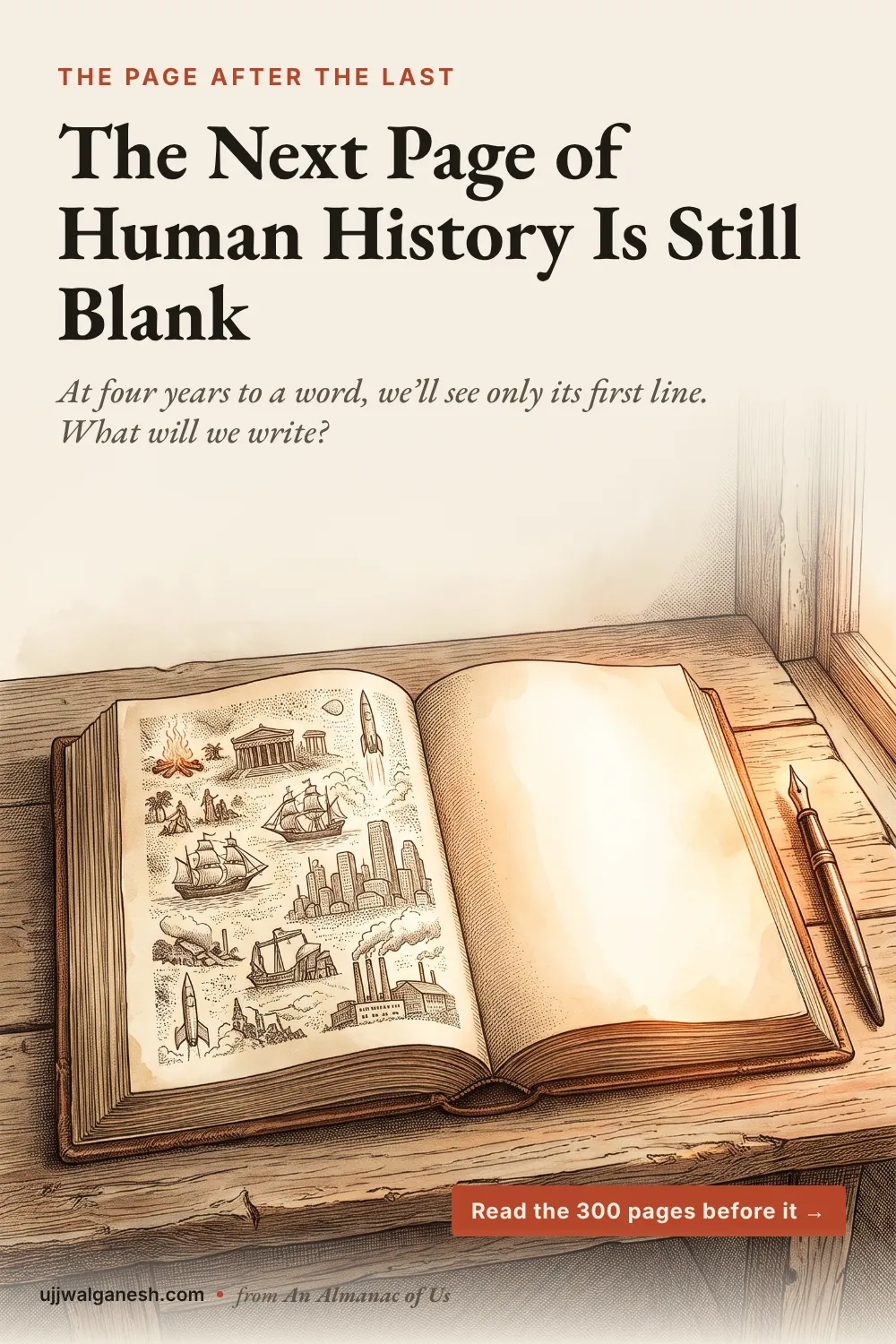
On the Almanac Clock, the page after the final word is blank. If the clock went on, that page would hold the next thousand years, at about four years to a word. Most of us will live to see only its first line or two.
Nobody else will write on it for us. What will we write?
Read the whole story in An Almanac of Us
I wrote this book. Links to Amazon are paid links: I earn a small commission on qualifying purchases, on top of my author royalty.
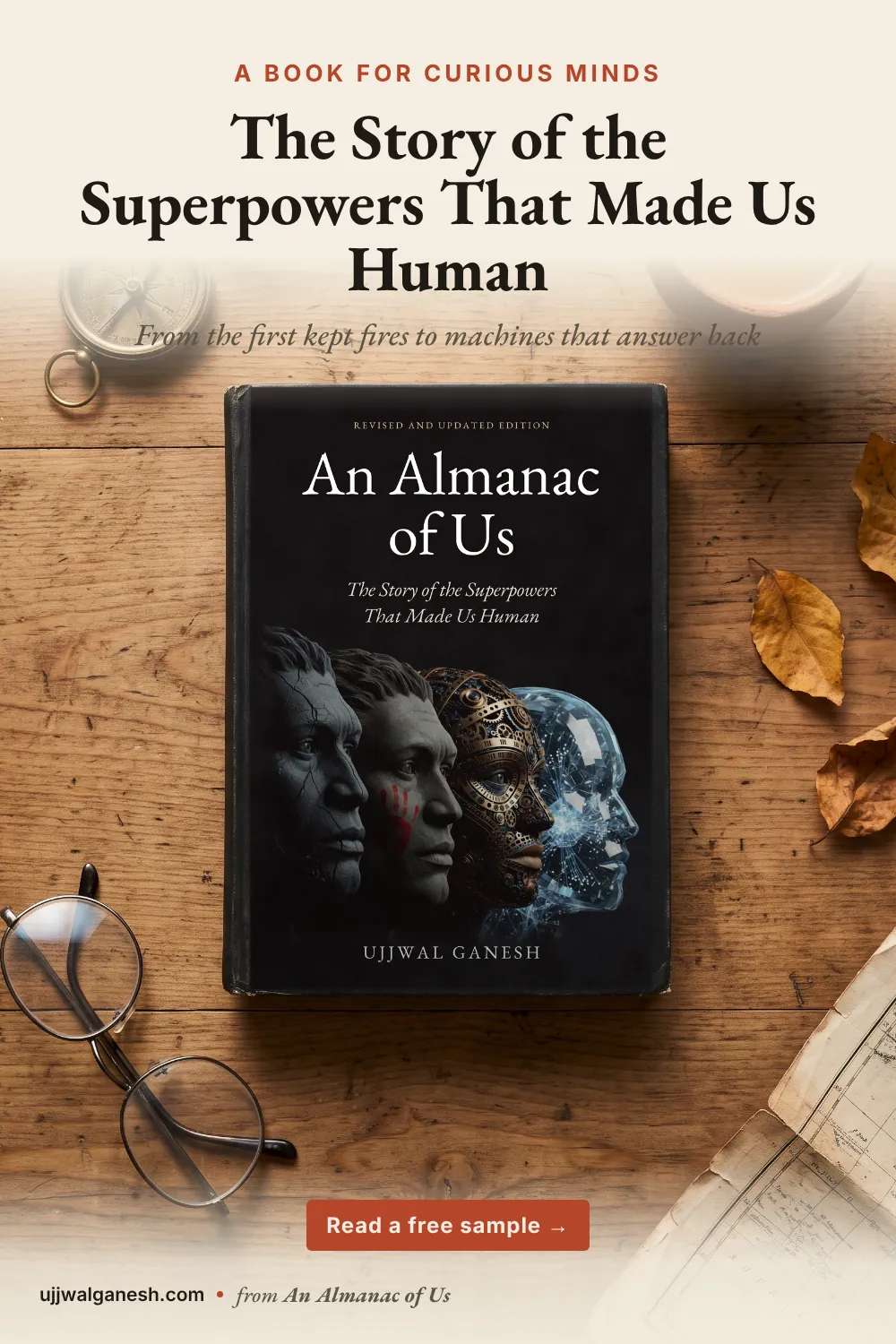
An Almanac of Us: The Story of the Superpowers That Made Us Human tells this story in fifteen chapters, from the first kept fires to machines that answer back, with the price of each power printed alongside it, and a few stories from a childhood in Bihar along the way.
Get it on Amazon: Kindle (paid link) · Paperback (paid link) · Hardcover (paid link)
Readers in India: Kindle on Amazon.in (paid link) · More about the book on its book page.
Frequently asked questions
How long have humans existed?
Our own species, Homo sapiens, has existed for about 300,000 years, based on fossils from Jebel Irhoud in Morocco. Earlier human species go back more than two million years, and some of them, such as Homo erectus, were already using fire.
When did writing begin?
Writing began in Mesopotamia, in the city of Uruk, between about 3300 and 3200 BCE, more than 5,000 years ago, and Egypt had its own writing at about the same time. Writing was also invented separately in China and in Mesoamerica.
What percentage of human history came before farming?
About 96%. Our species is roughly 300,000 years old, and farming began only about 11,500 years ago, so for about 288 of the 300 pages of the Almanac Clock everyone lived by hunting and gathering.
What is the Almanac Clock?
The Almanac Clock is a way of picturing human history as a 300-page book, with one page for every 1,000 years since the first people like us. On its last page, one word stands for about four years. It is the framework of the book An Almanac of Us by Ujjwal Ganesh.
Illustrations created with AI (Google Gemini) and edited by the author. Facts are drawn from An Almanac of Us, whose notes cite the original research.