“They have a great service and a wonderful team. I would highly recommend them!”
We have all seen this testimonial. It is polite. It is positive. And it converts absolutely no one.
In the modern marketplace, marketing has shifted from a monologue to a conversation. You are no longer the loudest voice in the room; your customers are.
Data shows that between 93% and 99% of consumers read online reviews before making a purchase. They trust strangers on the internet more than they trust your marketing department.
But here is the nuance most businesses miss: Not all testimonials are created equal.
A generic compliment is just noise. It’s the “vanilla ice cream” of social proof—inoffensive, but completely forgettable.
To bridge the “Trust Deficit” and turn skeptical visitors into buyers, you don’t need cheers; you need case studies. You need testimonials that tell a story.
The Restaurant Dilemma: Why We Follow the Crowd
To understand why social proof works, imagine you are walking down a street in a new city looking for dinner. You see two restaurants side-by-side.
Restaurant A (“Le Fantastique”): Has a beautiful, expensive sign in the window claiming “The Best Food in the City!” But when you look inside, the dining room is empty.
Restaurant B (“The Corner Bistro”): Has a simple, hand-painted sign. But inside, it is packed. You hear laughter, clinking glasses, and see happy diners.
Which one do you choose?
You choose the busy one. Instantly.
You ignored the marketing claim of Restaurant A and trusted the behavioral evidence of Restaurant B. This is social proof. We outsource our risk assessment to the crowd. If everyone else is there, it must be safe and good.
Your website is that street. Your testimonials are the crowd. If you have no reviews, or weak reviews, your digital restaurant looks empty.
The Anatomy of a Perfect Testimonial
So, how do you get testimonials that act like a packed dining room? You have to stop asking for “feedback” and start asking for stories.
A high-converting testimonial isn’t a random collection of adjectives. It is a strategic narrative that mirrors the customer’s own journey. It has a specific three-part anatomy:
1. The “Before” State (The Pain)
It starts by describing the specific frustration or problem the customer had before they found you. This allows your new visitor to say, “Hey, that’s exactly how I feel.”
2. The “After” State (The Outcome)
It paints a vivid picture of the result. Not just “it was good,” but the specific, tangible outcome. “I lost 15 pounds,” or “I saved 10 hours a week.”
3. The “Bridge” (The Solution)
It mentions the specific feature or aspect of your product that caused the transformation. This proves the result wasn’t luck; it was your product.
The Tale of the Two Tutors
Let’s see the difference in action. Imagine a mother, Sarah, looking for a math tutor for her struggling son. She finds two options.
TutorPro has this testimonial:
“TutorPro is fantastic! The tutors are so knowledgeable and friendly. We had a great experience!” – Jane D.
This is nice, but useless. It has no context.
MathMinds has this testimonial:
“Before we found MathMinds, Ethan was getting a D in algebra and his confidence was completely shot. After just two months with his tutor, Maria, he not only passed his final exam with a B+, but he actually started enjoying math. The way she used real-world examples to explain the concepts was the bridge that finally made it click.” – Sarah P.
Do you feel the difference?
The second testimonial isn’t just praise; it’s a journey. It takes the reader from anxiety (The Before) to relief (The After) via a specific method (The Bridge).
It doesn’t just sell tutoring; it sells the vision of a confident child.
Proof at the Point of Panic
Once you have these powerful stories, where do you put them?
Most businesses quarantine them on a dedicated “Testimonials” page. This is a mistake. No one goes there.
You must place your proof at the Point of Panic.
Think of your customer as a trapeze artist. The moment they have to click “Buy” or “Submit,” they are at the terrifying point where they have to let go of the bar and leap into the unknown. This is the “final five feet” of the conversion journey.
In that moment of maximum anxiety, they need a safety net.
- Don’t put your best testimonial on your About page.
- Do put it right next to the “Add to Cart” button.
- Do put your security badges and client logos right under the credit card field.
When you place evidence at the point of friction, it acts as a targeted antidote to anxiety.
Borrowing Trust from the Titans (Authority)
Social proof is the voice of the crowd. Authority is the voice of the experts.
If you are a new business, you might not have a crowd yet. In that case, you must borrow trust.
You do this by displaying Authority Signals:
- Press Logos: “As Seen In Forbes/TechCrunch.”
- Client Logos: “Trusted by Google/Nike.”
- Certifications: “ISO 9001 Certified.”
When a visitor sees the logo of a brand they already trust on your site, a “halo effect” occurs. The trust they have for that big brand is transferred to you. It is a trust transfusion.
Conclusion
You cannot demand trust. You must earn it, piece by piece.
By gathering story-driven testimonials, borrowing authority from established players, and placing that evidence exactly where your visitor feels the most fear, you build a fortress of credibility that skepticism cannot breach.
Your Next Step: You have built a persuasive engine with Clarity, Action, Urgency, Value, and Evidence. But is it working? You can’t manage what you don’t measure. Read the next article: The C.O.N.V.E.R.T. Method: A 7-Step Framework for Engineering Websites That Sell
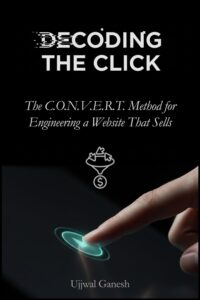
Evidence is the 5th principle of the C.O.N.V.E.R.T. Method. For the complete “Trust Architecture” map, including the 17 high-anxiety touchpoints where you must place proof to kill friction, get your copy of Decoding The Click.