You have done everything you were told to do.
You built a beautiful website. You hired the expensive agency. You poured a small fortune into Google Ads, obsessed over your SEO keywords, and churned out social media content until your fingers ached.
And it worked. The numbers in your analytics dashboard are climbing. The graph is going up and to the right. By all conventional metrics, your marketing is a success.
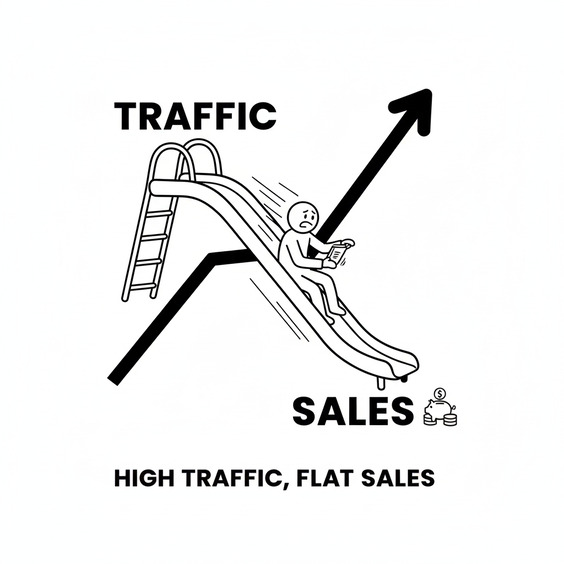
But then you look at your bank account. You look at your actual sales figures. And the feeling of success evaporates, replaced by a cold, gnawing frustration.
The traffic is there. But the sales are flat.
This is the story I hear in boardrooms and on video calls every single week. It is the silent tragedy of modern digital business: spending money to fill a bathtub while the drain is wide open.
If you are asking yourself, “Why is my website traffic not converting?”, I have some hard news for you.
You do not have a traffic problem. You have a conversion problem. And buying more traffic to fix it is just a faster way to go broke.
It’s time to stop looking at the water and start looking at the bucket.
Your Website Is a Leaky Bucket
For two decades, the marketing industry has been obsessed with one thing: “More.” More clicks, more eyeballs, more visitors. We have been conditioned to believe that traffic is the cure-all for every business ailment.
This obsession is a dangerous illusion.
Think of your business as a bucket. Your traffic—that precious, hard-won attention of potential customers—is the water you pour into it.
You are paying for that water. Every drop costs you money, time, and sweat. When you focus entirely on traffic, you are standing there with a hose, cranking the pressure higher and higher, trying to force the water level to rise.
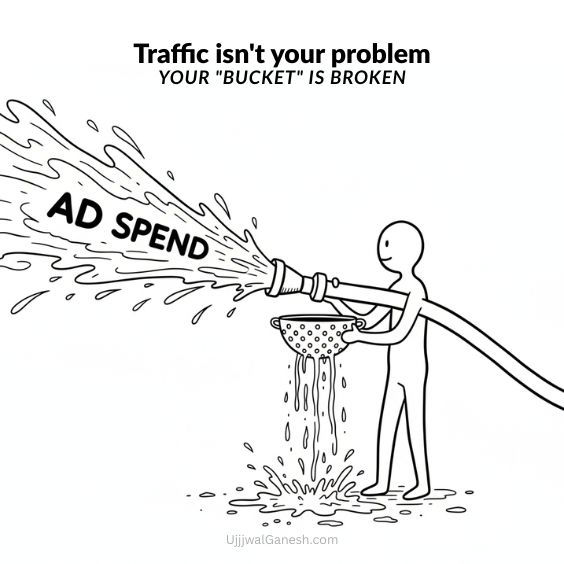
But your website—the bucket—is riddled with holes.
There are cracks in your navigation where people get lost. There are holes in your copywriting where people get confused. There are invisible fissures in your checkout process where frustration sets in.
The water pours in, and it leaks right back out.
The tragedy is that most business owners react to this by buying a bigger hose. They double their ad spend. They chase the latest TikTok trend. They scream louder.
But this is a losing game. You cannot out-spend a broken conversion process.
The Math of the Bucket
It is easy to dismiss conversion rate optimization (CRO) as a technical chore, something for the data geeks to worry about later. But in the mathematics of business, a small hinge swings a very large door.
Let’s look at the numbers.
Imagine your website gets 10,000 visitors a month. Your current conversion rate is 1% (a fairly typical number for many industries). That means you get 100 sales.
Now, you have two choices to grow:
Option A: The Traffic Approach. You want to double your sales to 200. To do this with your current conversion rate, you need to double your traffic to 20,000 visitors. That means doubling your ad budget, doubling your content output, and doubling your effort.
Option B: The Conversion Approach. You keep your traffic exactly the same. You don’t spend a penny more on ads. Instead, you fix the leaks. You increase conversion rate from 1% to 2%.
Suddenly, you have the same 200 sales. But your profit margins have exploded because your acquisition costs remained flat.
This is the power of fixing the bucket. It is the single most profitable lever you can pull in your business. But to pull it, you first have to find the holes.
Where Your Traffic Actually Goes (The Invisible Cracks)
If 99 out of 100 people leave your website without buying, where are they going? They aren’t vanishing into thin air. They are hitting specific, identifiable friction points—invisible cracks—that force them to abandon ship.
Most business owners assume their product is too expensive or the market is “slow.” In reality, the leaks are often much simpler, and much more painful.
Here are three of the most common places your ROI is draining away:
1. The Clarity Leak (The 5-Second Fail)
This is usually the biggest hole in the bucket. A visitor lands on your site. They are lazy, impatient, and distracted.
They give you exactly five seconds to answer three questions:
- Where am I?
- What can I do here?
- Why should I stay?
If your headline is vague (“Welcome to the Future of Solutions”), or your design is cluttered, they don’t stick around to figure it out. They hit the back button. You paid for the click, but you lost the attention.
2. The Speed Leak
We live in the currency of “Now.” A single one-second delay in your website’s page load time can slash your conversion rate by 7%.
If your site takes four seconds to load, you have likely lost a quarter of your potential revenue before the user even sees your headline. That isn’t a marketing problem; that is a technical leak costing you thousands.
3. The “So What?” Leak
You might be listing features. “20GB of storage.” “Titanium alloy.” “24/7 support.”
But your visitor doesn’t buy features. They buy transformation. They buy the “After State”—the better version of themselves they become after using your product.
If your copy speaks to the drill bit (the feature) rather than the hole in the wall (the outcome), you are leaking authority and connection.
The 99% Reality Check
Run a quick diagnostic on your own business right now.
Take your total unique visitors from last month. Take your total number of sales.
If you had 1,000 visitors and 10 sales, you have a 99% leak rate.
Let that sink in. 990 people—people you likely paid to reach—walked into your store, looked around, and walked out empty-handed.
That is not a traffic problem. That is a bucket problem.
The Conversion Imperative: Fix the Bucket First
So, how do we patch the holes?
For too long, we’ve been told that website conversion optimization is about “best practices.” We’re told to change the button color to green, or make the logo bigger.
This is guesswork. And guesswork is the most expensive habit in business.
You don’t need random tactics. You need a system. You need a blueprint for engineering a website that sells, based on the psychological realities of your user.
In my book, Decoding The Click, I introduce this system as the C.O.N.V.E.R.T. Method. It is a framework designed to systematically address the seven critical areas where websites leak revenue:
- Clarity: Fixing the message so it lands in 5 seconds.
- Obvious Action: Creating a frictionless path to the “Buy” button.
- Now: Using ethical urgency to stop procrastination.
- Value: Stacking the offer so the price feels irrelevant.
- Evidence: Building bulletproof trust to kill skepticism.
- Refinement: Finding the leaks with data.
- Testing: Proving what works scientifically.
We don’t have time to cover the entire framework in one article (that’s why I wrote the book), but we can start with the most critical step: visibility.
Start With Visibility
You cannot fix what you cannot see.
The first step to traffic but no sales recovery is to stop flying blind. You need to turn on the lights in the basement.
If you haven’t already, install Google Analytics (or a similar tool). Do not look at the vanity metrics like “Total Pageviews.” Look at your Purchase Journey.
Map out the steps a user must take to buy from you.
- Step 1: Land on Homepage.
- Step 2: View Product Page.
- Step 3: Add to Cart.
- Step 4: Purchase.
Now, look at the drop-off between those steps.
Are 80% of people leaving after Step 1? That is your leak. It means your message isn’t clear (Clarity) or your navigation is broken (Obvious Action).
Are people viewing the product but not adding to cart? That is your leak. It means your offer isn’t compelling (Value) or they don’t trust you (Evidence).
Finding the leak is the detective work. Fixing it is the engineering.
Stop Guessing, Start Growing
If you take one thing away from this article, let it be this:
More traffic will not save a broken website. It will only accelerate the rate at which you waste your budget.
Your website should not be a mystery. It should be a machine. A predictable, reliable engine for turning visitors into customers.
The water is expensive. The bucket is what you control. It’s time to seal the cracks.
Your Next Step: Finding the leaks is just the beginning. To fix them, you need to understand why they are happening. It starts with the first 5 seconds of the user experience. Read the next article in this series: The 5-Second Rule: Why First-Time Visitors Leave Your Website Instantly
This article introduces the “leaky bucket” concept, a core philosophy of the C.O.N.V.E.R.T. Method. For the complete diagnostic framework, leak-finding templates, and the step-by-step system to fix your conversion funnel, get your copy of Decoding The Click.