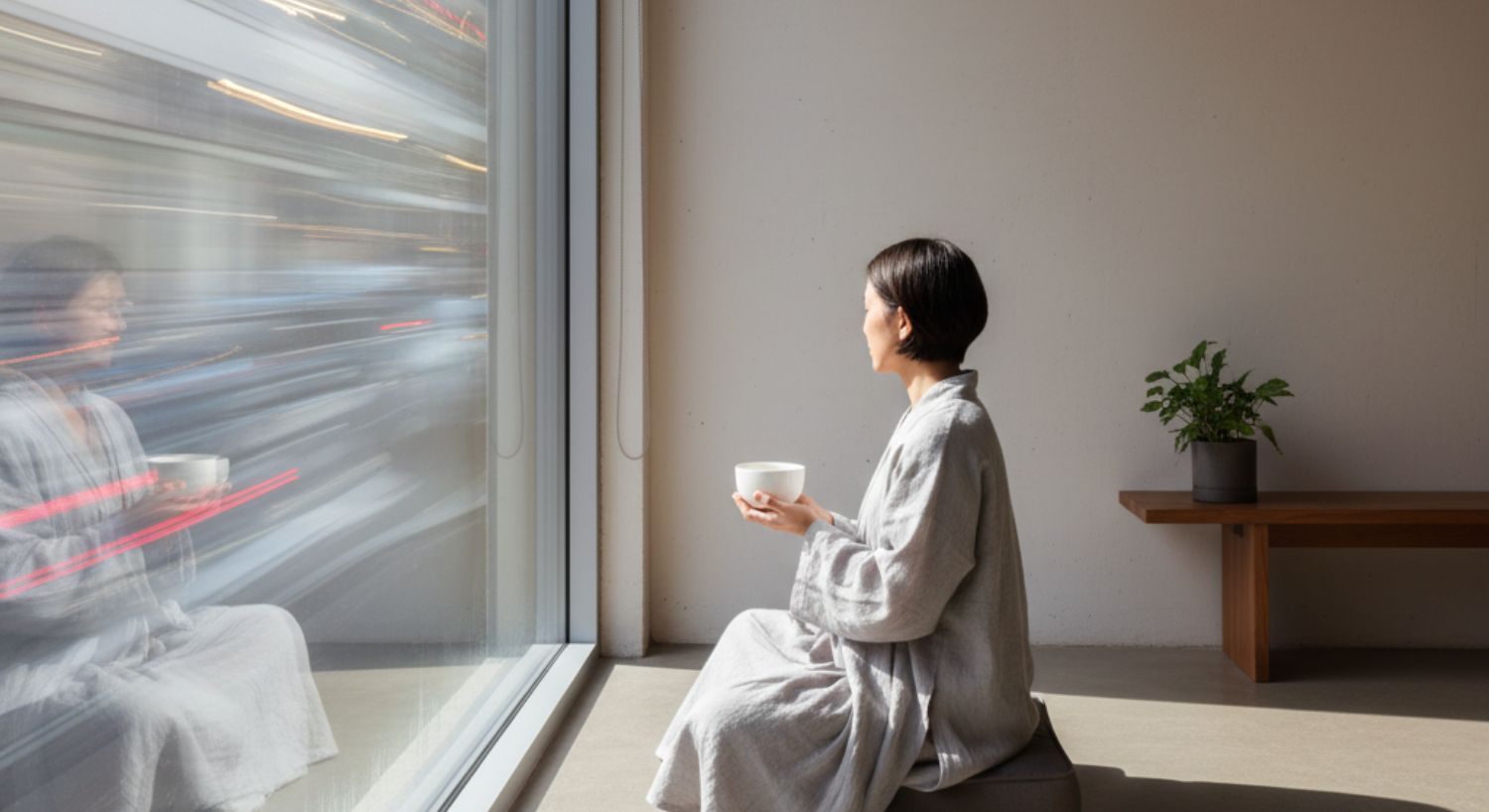
The aroma of coffee begins to fill the kitchen. You find yourself holding a warm mug, the steam curling up towards your face. You take a sip. It’s perfect. But then a strange question pops into your head: Did I add the sugar?
You can’t quite remember scooping it into the mug. You don’t recall the clink of the spoon or the motion of stirring. You went through the entire, multi-step process of making your morning coffee—a ritual you’ve performed thousands of times—completely on autopilot.
This is the work of the ghost in your head.
In our last discussion, we explored how this powerful autopilot system filters out 99% of reality to save energy. Today, we’re moving beyond the what and into the how. This is your practical guide to seeing the filter itself. Learning to spot this ghost is the first and most critical skill for taking back control of your attention and living a more intentional, examined life.
Why Spotting the Ghost is a Modern Superpower
First, let’s be clear: the ghost, or what scientists call the Default Mode Network (DMN), isn’t an enemy. It’s your brain’s efficiency expert. Its ability to handle routine tasks without conscious effort is what allows you to think about your day’s schedule while you tie your shoes.
The problem arises when the DMN is left to run the show unchecked, pulling us into a constant stream of past regrets and future anxieties, causing us to miss our actual lives. Learning to spot the ghost in action is a foundational skill—a kind of superpower in our distraction-filled world—for several key reasons:
- It Builds Metacognition: Spotting the ghost is a direct exercise in metacognition, or “thinking about thinking.” This ability to observe your own mental state from a higher vantage point is strongly linked to improved learning, more effective problem-solving, and greater emotional regulation.
- It’s the First Step to Changing Habits: As habit expert James Clear notes, every habit is triggered by a cue. Often, our most stubborn bad habits (like mindless snacking or compulsive phone checking) are triggered unconsciously by the ghost. You cannot change a habit until you are aware of the cue that starts the loop. Spotting the ghost is the act of seeing that cue clearly for the first time.
- It Creates a Space for Choice: When you’re on autopilot, you are purely reactive. An external event happens, and you react according to your pre-programmed script. By spotting the ghost, you create a tiny, precious gap between stimulus and response. In that gap lies your freedom to choose a different path.
Your 3-Step Guide to Becoming a “Ghost Hunter”
This is not a passive exercise; it’s an active practice. Think of yourself as a detective learning to spot clues. Here is a simple, three-step method to begin your training.
Step 1: Identify Your “Autopilot Zones”
The ghost loves familiar routines. The first step is to map out its favorite hiding places. These are your personal “autopilot zones,” the moments in your day where you are most likely to zone out. Take a minute right now and identify 3-5 of them. They might include:
- Your daily commute
- Your morning or evening routine (showering, brushing your teeth)
- Household chores (washing dishes, walking the dog)
- Exercise routines (running on a treadmill, lifting weights)
- Mindless scrolling on social media
These zones are your training grounds. By consciously identifying them, you are priming your brain to be on alert, turning a routine activity into an opportunity for observation.
Step 2: Use Pattern Interrupts
The easiest way to spot the ghost is to set a trap for it. A pattern interrupt is a small, deliberate change to a routine that forces your conscious brain to take over from the autopilot. It’s like placing a small pebble on the well-worn path of a habit, forcing you to wake up and watch your step.
Try one of these simple interrupts this week:
- Switch hands: Brush your teeth or use your computer mouse with your non-dominant hand. The awkwardness will force you to be present.
- Change your route: Take a different street on your commute or your daily walk. The new scenery will require your active attention.
- Alter the sequence: If you normally shower and then get dressed, try getting dressed and then doing something else before showering. Break the automatic chain of events.
The goal of a pattern interrupt isn’t to be more efficient; it’s to create a moment of intentional friction that makes the ghost visible.
Step 3: Practice the 1-Minute Ghost Hunt
This is your daily training exercise. It’s a simple, 60-second mindfulness practice designed to strengthen your “noticing” muscle.
- Set a timer for one minute. Find a quiet place to sit.
- Your only task is to observe your breath. Don’t try to change it. Just feel the sensation of air entering and leaving your body.
- Sooner or later, your mind will wander. A thought, a memory, a plan—this is the ghost taking over.
- The moment you realize your mind has drifted, celebrate quietly. That is the victory. You have successfully spotted the ghost.
- Gently, and without frustration, return your focus to your breath.
That’s it. The point isn’t to prevent your mind from wandering; the point is to get better at noticing when it wanders. Each time you do, you’re building the neural pathways for self-awareness.
From Spotting to Directing
Once you get better at spotting the ghost, the next question is: what do you do with it? The answer is crucial: you do nothing.
You don’t fight it. You don’t try to suppress it. You don’t judge yourself for it.
You simply notice it, acknowledge it, and gently guide your attention back to the present. Think of it like this: the ghost is the actor on the stage, lost in the drama. Your job is to be the calm director in the chair who simply says, “And… back to the scene.”
This practice of non-judgmental observation is the key to transforming your inner world. The more you practice, the less time you’ll spend as a reactive character in the ghost’s story and the more time you’ll spend as the conscious author of your own life.
This guide provides the foundational tools for spotting the ghost. In my book, The Observation Effect, we dive deeper into a full suite of techniques for directing your attention, including powerful methods for grounding yourself and reading the world around you with stunning new clarity. The journey begins not with a grand battle, but with the quiet, revolutionary act of noticing.