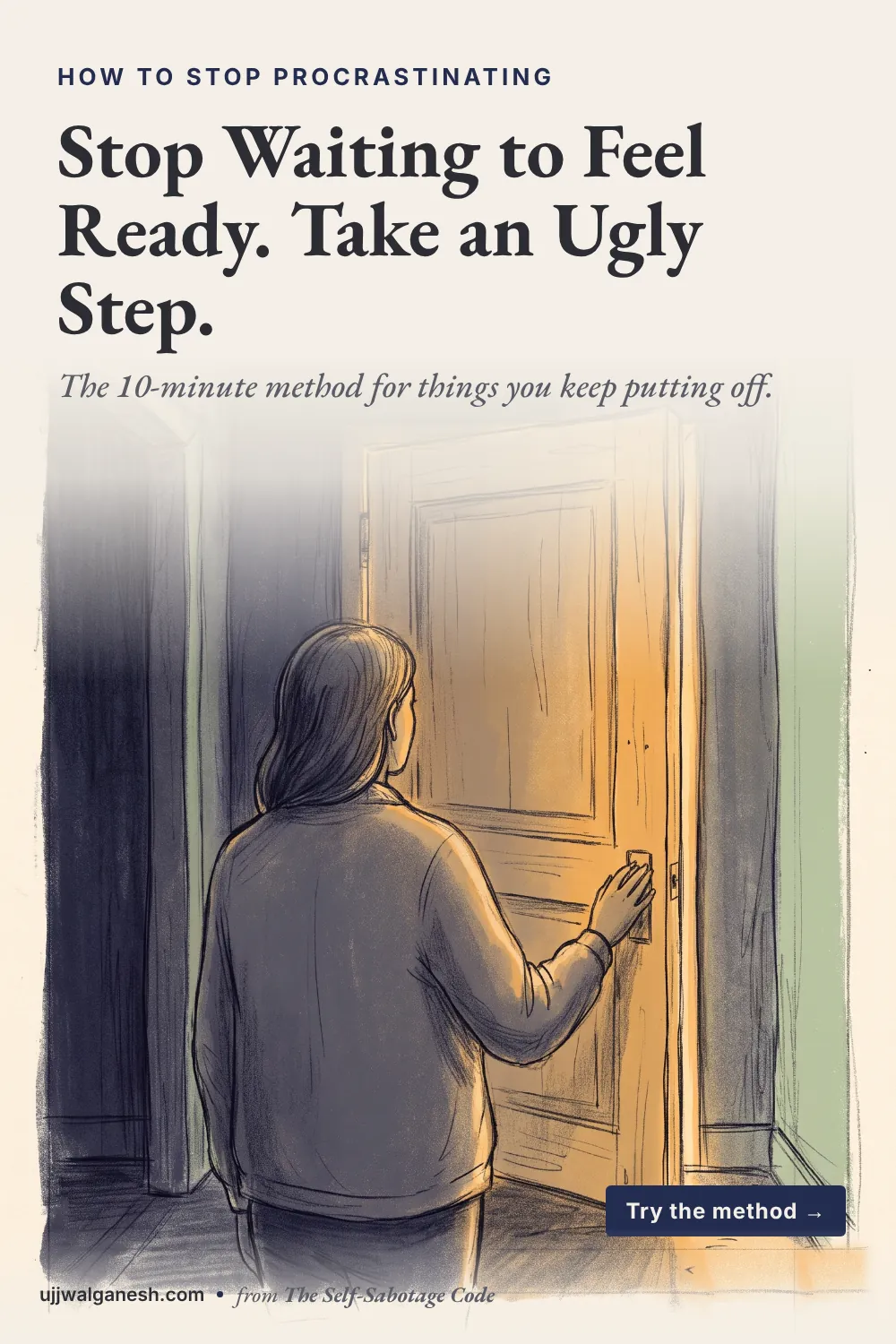
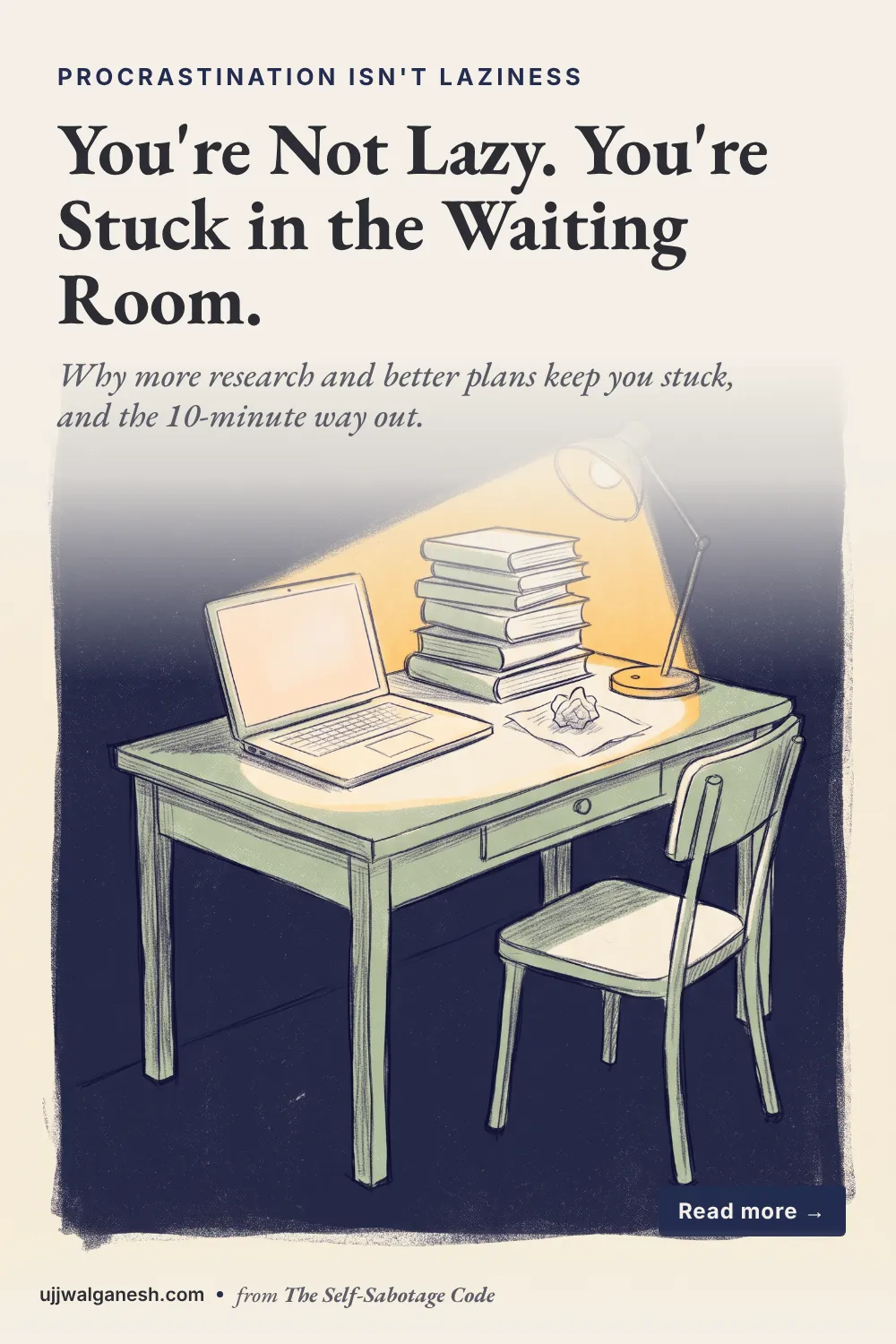
You have a thing. The book you keep meaning to write. The course you bought and never opened. The call you keep moving to next week. You are not lazy. You have probably researched it more than anyone you know. You are just waiting: for more time, more confidence, a calmer month, the right moment.
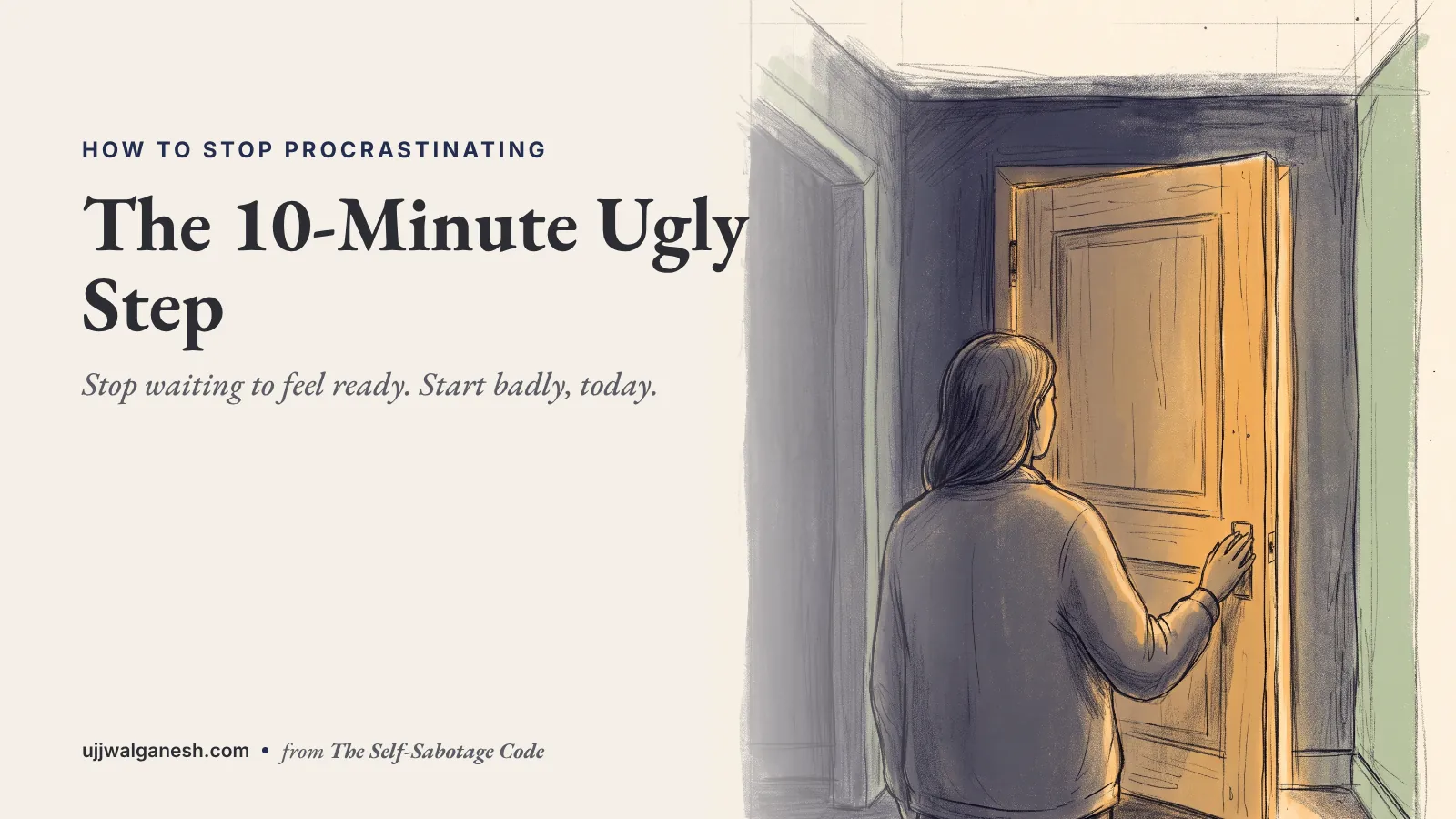
In my book The Self-Sabotage Code I call this place the Waiting Room, where your life is always about to begin. This post gives you the simplest way out I know. It is called the Ugly Step, and it takes about ten minutes.
In this post:
- Why “just start” doesn’t work
- What is an Ugly Step?
- Why ugly works better than perfect
- The Ugly Step method in 5 steps
- The 48-hour challenge
- Frozen? The 10-minute emergency plan
- 12 ugly steps you can borrow
- What not to do after your ugly step
- Frequently asked questions
Why “just start” doesn’t work
“Just start” is good advice that almost never works, because it is too vague. It leaves room for your brain to negotiate. Start with what? When? Which part first? Every question is a chance to add one more condition, and every condition is another reason to wait.
There is a feeling side too. Psychologists Fuschia Sirois and Tim Pychyl describe procrastination as a way of feeling better now at the expense of your future self: putting the task off eases today’s discomfort and hands the bill to tomorrow. That is why more planning, more research and a better app rarely help. They feel productive, and they keep you safely away from the uncomfortable part, which is starting.
The fix is not more motivation. As I put it in the book: motivation follows action, not the reverse.
What is an Ugly Step?
The Ugly Step is the smallest, most imperfect action you can take right now toward what you actually want. Not the strategic action. Not the optimal one. Not the action you would take if conditions were right and you felt ready. The ugliest, least impressive action that still moves you forward.
- If you want to write a book, the ugly step isn’t “outline chapter one”. It’s “write one terrible sentence”.
- If you want to start a business, it isn’t “create a business plan”. It’s “send one awkward message to someone who might be a customer”.
- If you want to get fit, it isn’t “design the perfect workout programme”. It’s “do one embarrassing push-up in your work clothes”.
Why ugly works better than perfect
There are two reasons.
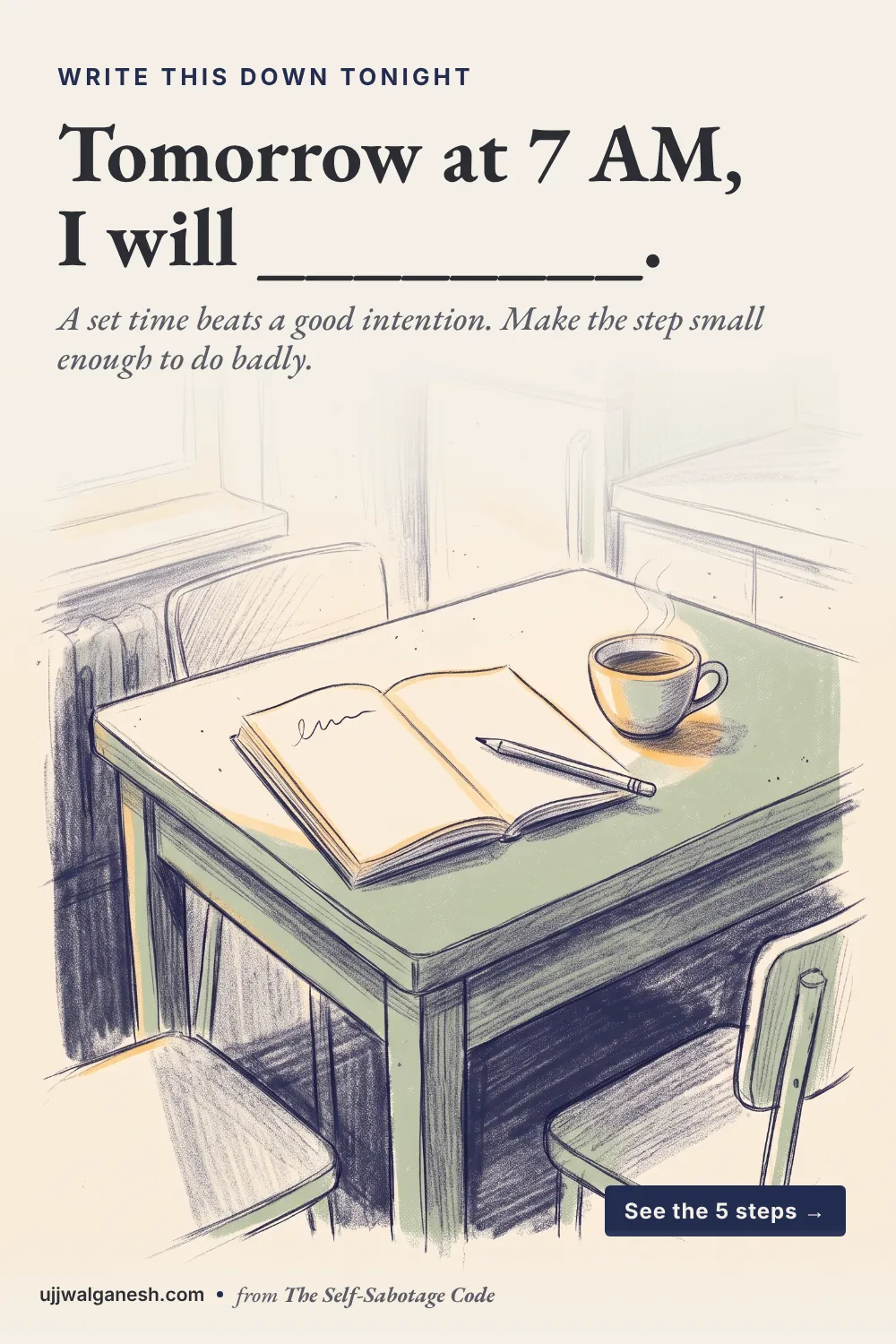
A specific plan beats a good intention. Psychologists call plans like “If it’s 7 AM, then I write one bad paragraph” implementation intentions. In a 2006 review that pooled 94 independent tests, Peter Gollwitzer and Paschal Sheeran found that if-then plans like this had a medium-to-large effect on whether people reached their goals. The plan closes the gap between deciding and doing, which is exactly where your brain usually starts listing reasons to wait.
Repetition breaks patterns. Quality doesn’t. “Write one terrible sentence every day” creates more writers than “write when you feel inspired” ever has. The ugly version actually happens. The perfect version waits for conditions that never arrive.
The Ugly Step method in 5 steps
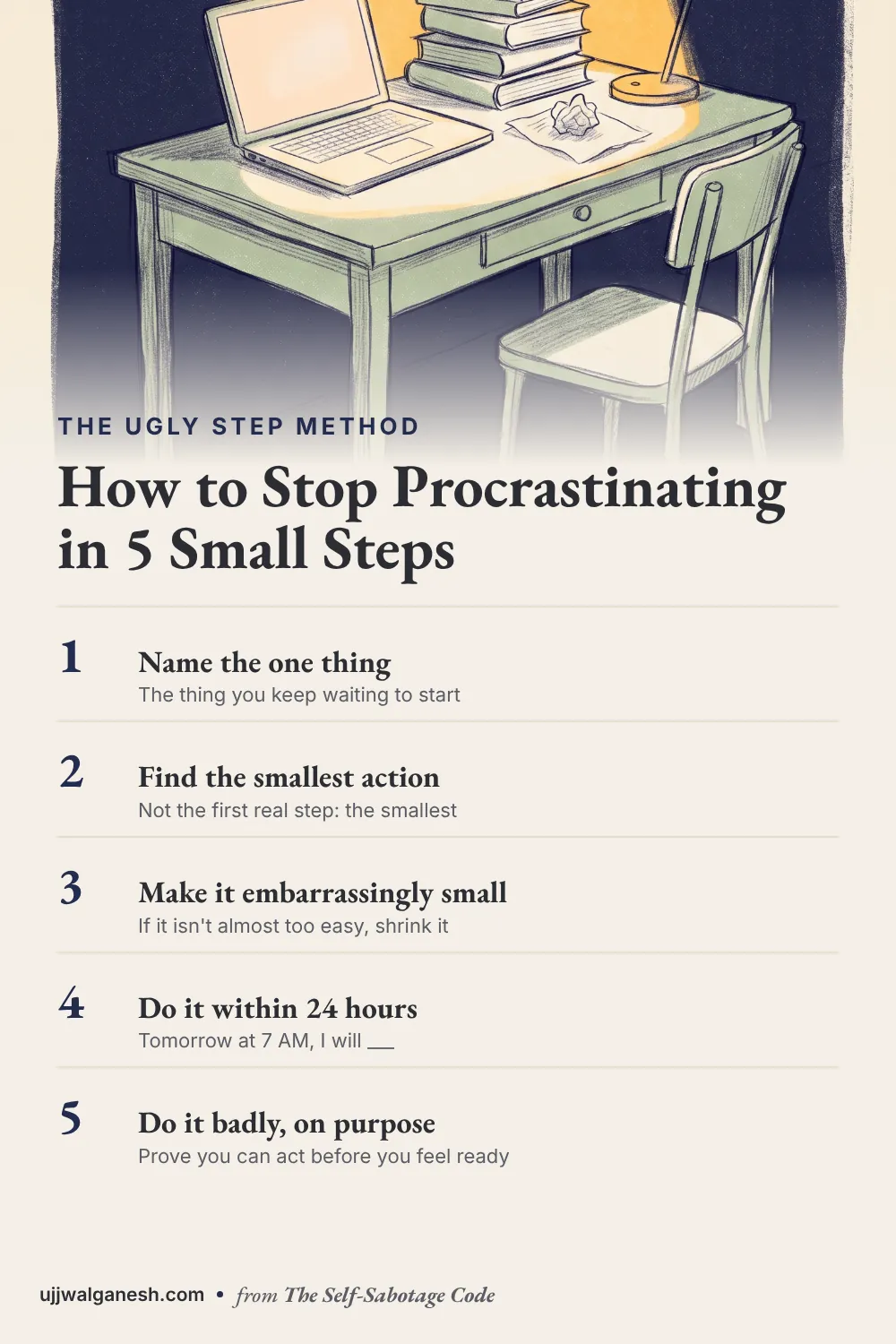
- Name the thing you’ve been waiting to start. One thing. Write it down so it is real.
- Find the smallest possible action. Not the first “real” step. The smallest possible movement.
- Make it embarrassingly small. If it doesn’t feel almost insultingly easy, it is too big.
- Do it within 24 hours, at a set time. Not “soon” and not “this week”. Write it down: “Tomorrow at 7 AM, I will ___.”
- Do it badly, on purpose. You are not trying to do it well. You are proving to yourself that you can act before you feel ready.
Expect it to feel wrong. It will feel insufficient, as if it doesn’t count. It will feel embarrassing, because you are capable of better. It will feel pointless, because one terrible sentence doesn’t make you a writer. All of that is fine. You are not trying to become anything today. You are breaking the rule that says you can’t do anything until you can do it perfectly. Your standards have been a prison. Let them go, just for today.
The 48-hour challenge
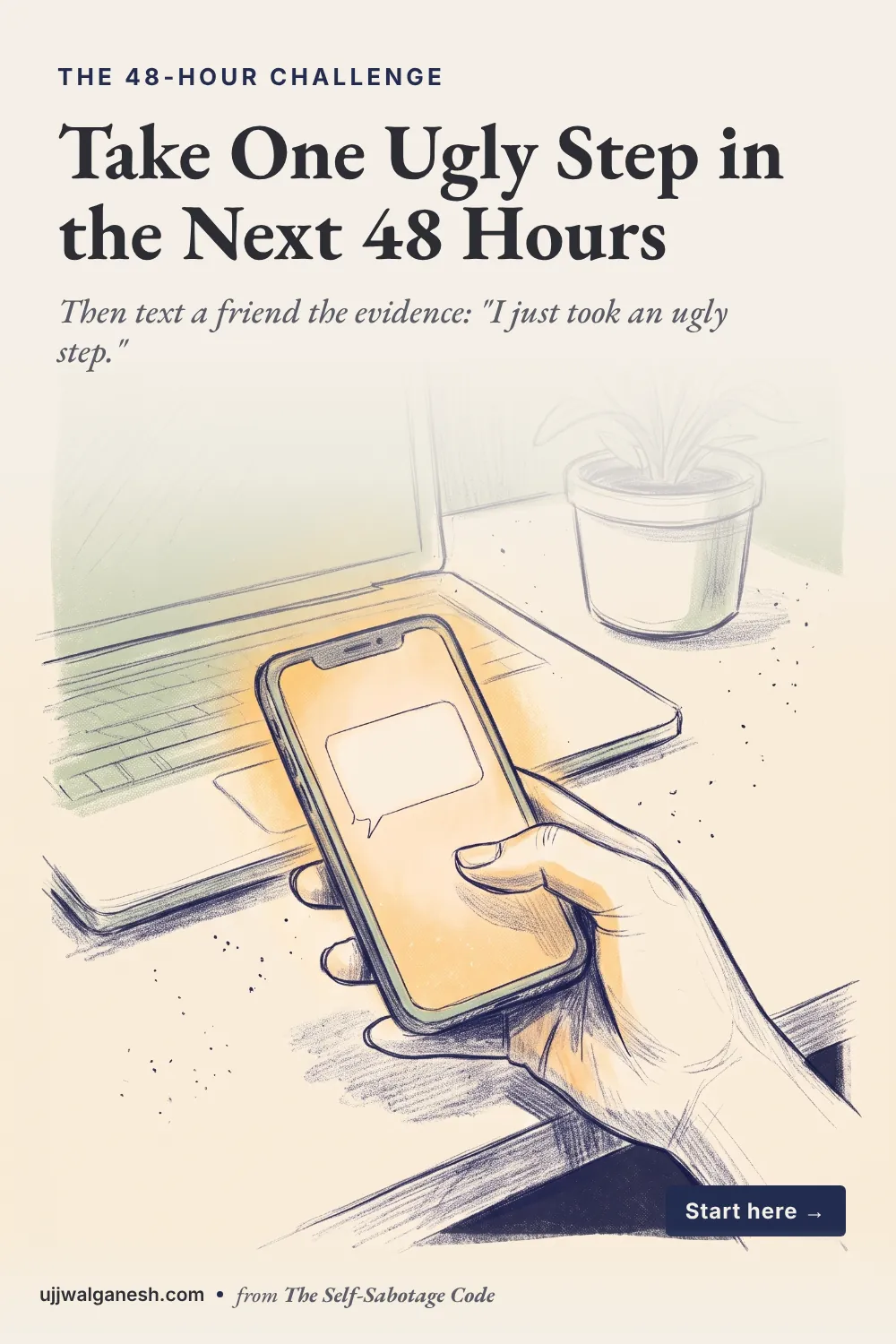
Within 48 hours, take one ugly step toward the thing you named. Then write down what you did and when, or text a friend a photo of the evidence. Not what you learned, and not what you plan to do next: what you actually, physically did.
Then notice what happens. Nothing terrible. The world carries on, and the next step looks a little smaller than it did yesterday. Ugly action creates more momentum than perfect preparation ever has.
Frozen? The 10-minute emergency plan
Some days you can’t even decide what to do first. For those days, the book has a short emergency plan:
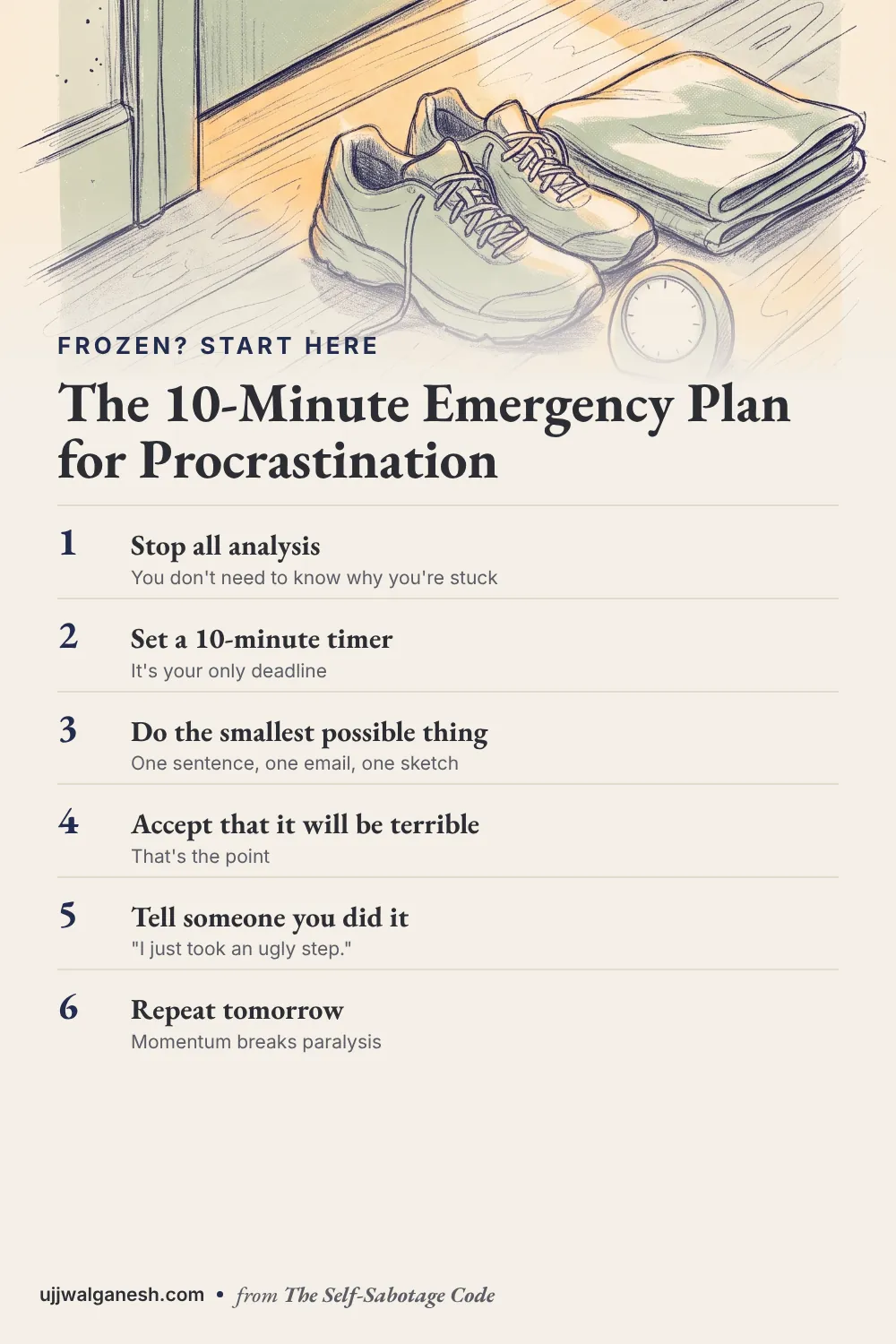
- Stop all analysis. You don’t need to work out why you’re stuck.
- Set a 10-minute timer. It is your only deadline.
- Do the smallest possible thing. One sentence, one email, one sketch, one anything.
- Accept that it will be terrible. That’s the point.
- Tell someone you did it. One text, six words: “I just took an ugly step.”
- Repeat tomorrow. Momentum breaks paralysis. Diagnosis can wait.
12 ugly steps you can borrow
The first three come from the book. The rest are in the same spirit. Pick the one closest to your thing and shrink it further if you can.
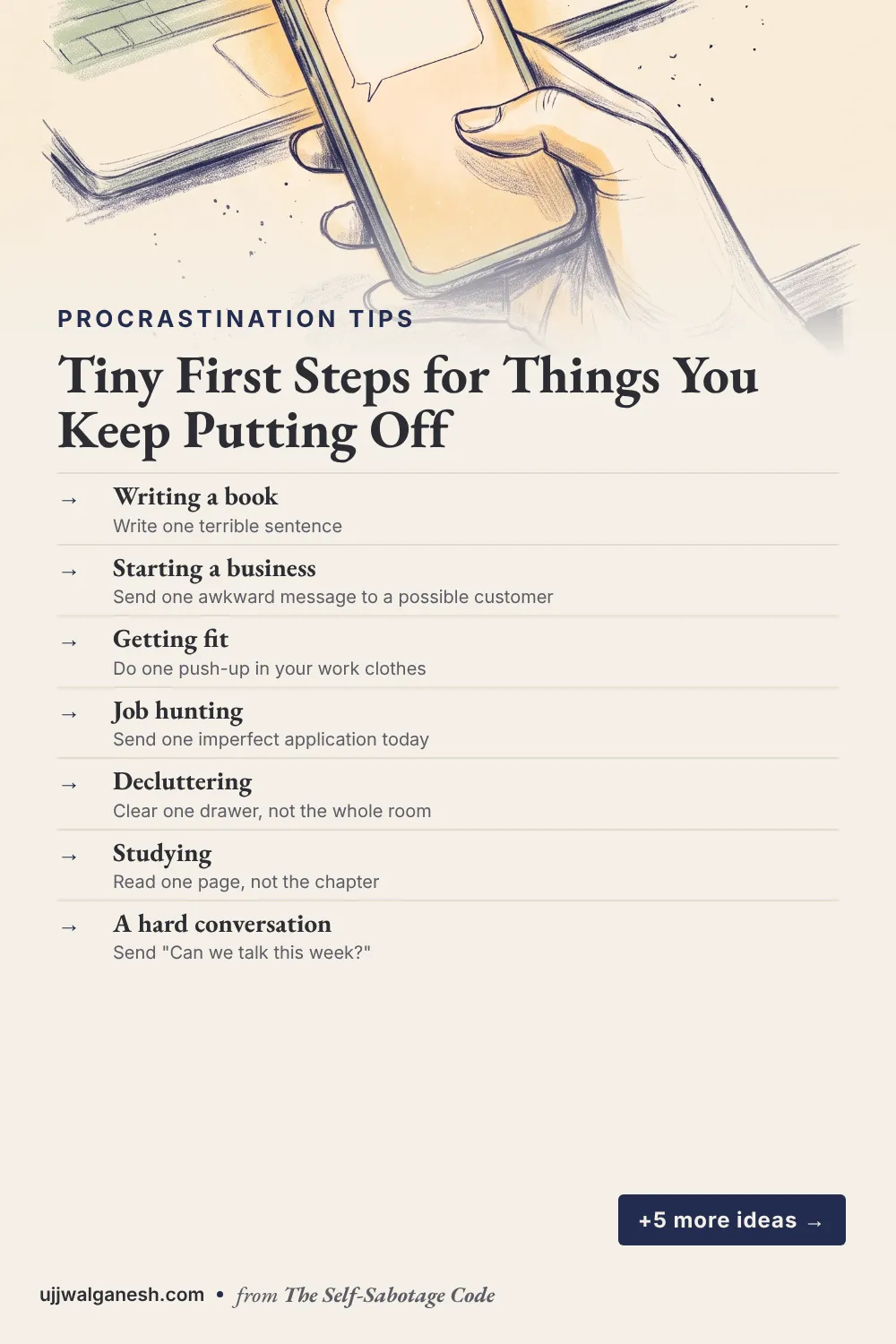
- Writing a book: write one terrible sentence.
- Starting a business: send one awkward message to a possible customer.
- Getting fit: do one push-up in your work clothes.
- Learning a language: say five words out loud, badly.
- Job hunting: send one imperfect application, or message one person at a company you admire.
- Starting a blog or channel: publish one rough paragraph, or record a 60-second video with no edits.
- Decluttering: clear one drawer, not the whole room.
- Studying: read one page, not the chapter.
- Drawing: sketch the cup on your desk, wobbly lines and all.
- Music: play one song all the way through, mistakes included.
- A difficult conversation: send “Can we talk this week?”
- A postponed appointment: make the booking, even if the date is weeks away.
What not to do after your ugly step
The Waiting Room is clever. Once you act, it tries to turn the action back into preparation. So, for today:
- Don’t journal about what you learned. That’s collecting again.
- Don’t build a plan for the next 30 days. That’s researching again.
- Don’t announce what you’re going to do next. Tell people what you did, not what you will do.
- Don’t wait to feel motivated. Motivation follows action.
- Don’t hunt for the “right” ugly step. There is no right one. There’s just one.
When it’s more than procrastination
Small steps help with everyday procrastination. If putting things off comes with low mood that won’t lift, trouble focusing on almost everything, or it is seriously hurting your work, sleep or relationships, please talk to a doctor or a counsellor. Sometimes something else sits underneath, and it deserves real help, not just a better method.
Go deeper: The Self-Sabotage Code
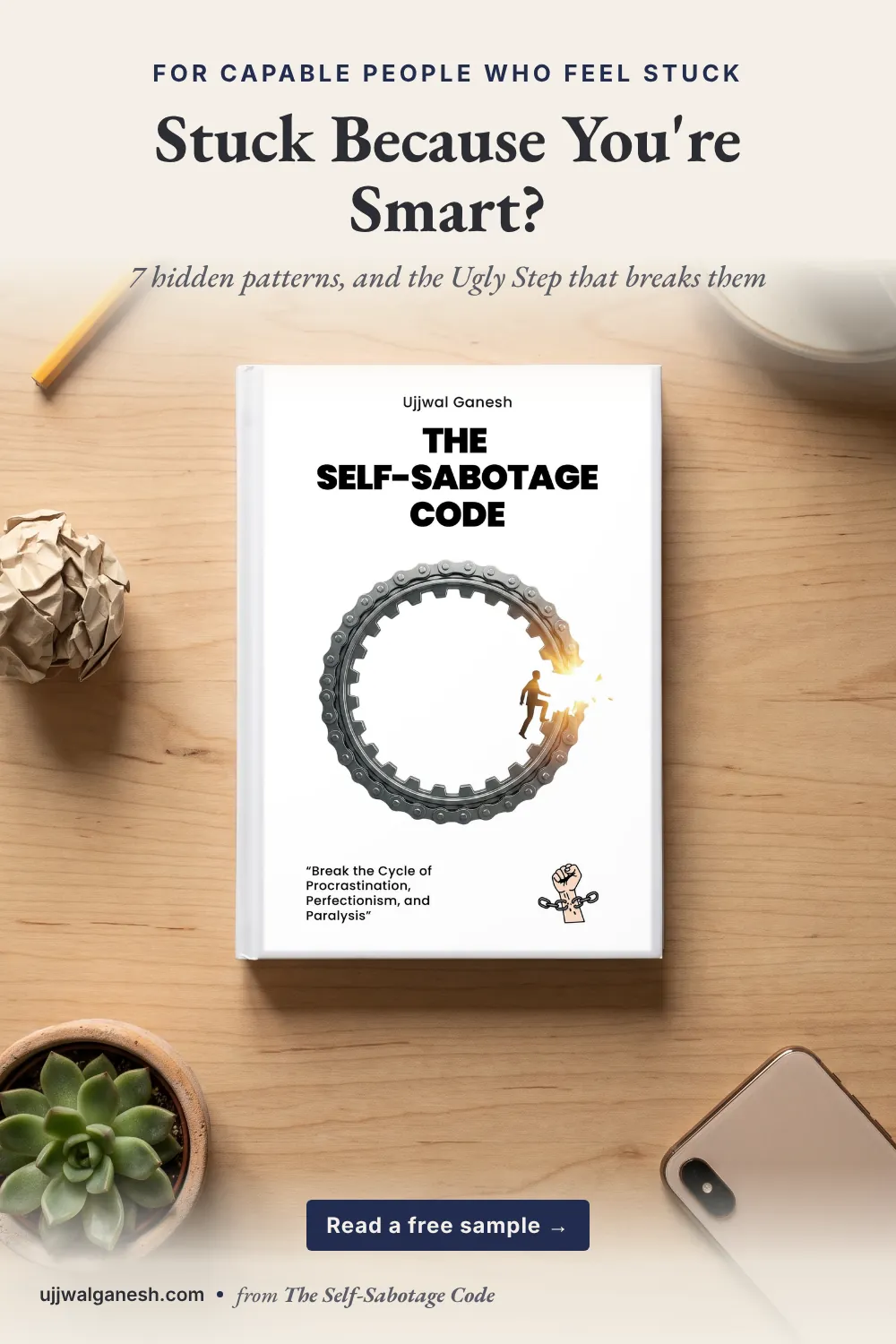
The Ugly Step is the first protocol in my book The Self-Sabotage Code: Break the Cycle of Procrastination, Perfectionism, and Paralysis. It names seven hidden patterns that keep capable people stuck, from waiting for the right time and hoarding information to endless research and rehearsing conversations instead of having them, and gives each one its own ugly step. It is not a cure. It is a way to see the pattern and act anyway.
I wrote this book. Links to Amazon are paid links: I earn a small commission on qualifying purchases, on top of my author royalty.
Get it on Amazon: Kindle (paid link) · Paperback (paid link) · Hardcover (paid link)
Readers in India: Kindle on Amazon.in (paid link) · More about the book on its book page.
Frequently asked questions
How do I stop procrastinating when I have no motivation?
Don’t wait for motivation. Shrink the task until it needs almost none: a ten-minute, deliberately imperfect version you can do today. Motivation usually shows up after you start, not before.
Why do I procrastinate on things I actually want to do?
Often because they matter. The more something means to you, the more a bad result would sting, so waiting feels safer than trying. Researchers also link procrastination to short-term mood repair: delaying eases the discomfort now and passes it to your future self.
How small should the first step be?
Small enough to feel almost insultingly easy and to fit into about ten minutes today. If you catch yourself planning the step, it’s still too big.
Illustrations created with AI (Google Gemini) and edited by the author. The method is adapted from The Self-Sabotage Code. Sources: Gollwitzer, P. M. & Sheeran, P. (2006), “Implementation intentions and goal achievement: a meta-analysis of effects and processes”, Advances in Experimental Social Psychology 38; Sirois, F. & Pychyl, T. (2013), “Procrastination and the priority of short-term mood regulation”, Social and Personality Psychology Compass 7(2).