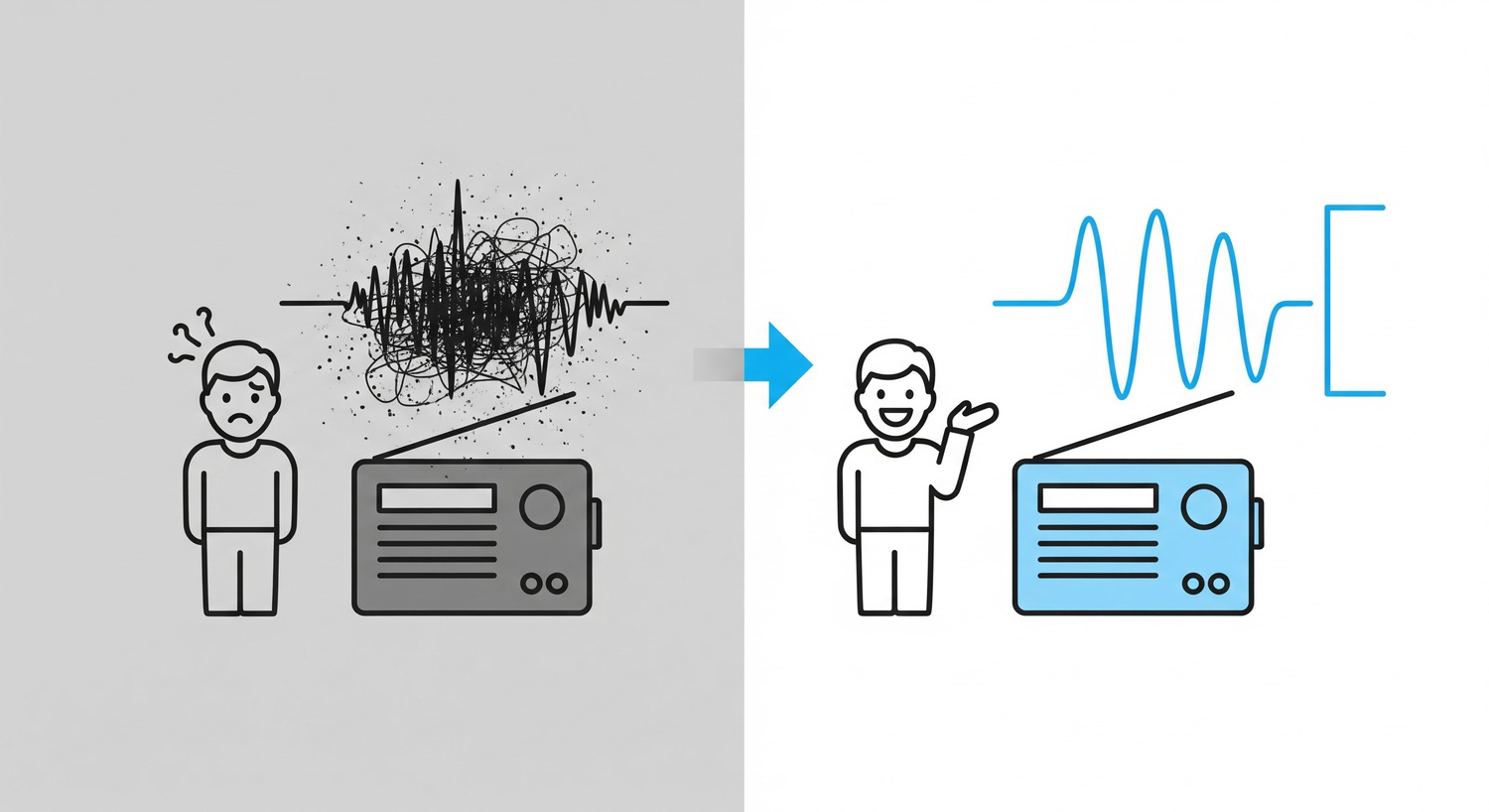
Random tactics create random results. Systems create predictable growth.
This is the difference between a hobbyist and a professional. The hobbyist tries a new “trick” they read on a blog—changing button colors, rewriting a headline, adding a pop-up. Sometimes it works; usually, it doesn’t. They never know why.
The professional builds a machine.
If you are tired of guessing why your traffic isn’t converting, you don’t need another “top 10 marketing tip.” You need a system. You need a comprehensive website conversion strategy that addresses every psychological barrier between your visitor and the “Buy” button.
In my book, Decoding The Click, I outline this system. It is called the C.O.N.V.E.R.T. Method.
It is not a checklist of disconnected best practices. It is a conversion optimization framework where each step builds on the last, creating a flywheel of continuous improvement.
Here is the blueprint for engineering a website that sells.
Why You Need a Framework (Not Just Duct Tape)
Most businesses treat conversion optimization like patching a leaky bucket with duct tape. They fix one hole (like a slow loading speed) but ignore six others (like a confusing value proposition or lack of trust).
A framework forces you to look at the entire system. It ensures you aren’t just optimizing a page, but optimizing the mindset of your visitor.
The C.O.N.V.E.R.T. Method addresses the four foundational truths of user behavior: Laziness, Impatience, Judgment, and Skepticism.
The 7 Principles of the C.O.N.V.E.R.T. Method
C – CLARITY: The 5-Second Rule
The Problem: Visitors are lazy and impatient. If they have to think to understand what you do, they leave. The Solution: You must pass the “Triage Test.” Within 5 seconds, your “Hero Section” (Headline + Sub-headline + Image) must answer: Where am I? What can I do here? Why should I stay? Quick Win: Run the 5-Second Test on your homepage with a stranger. If they can’t explain your business after 5 seconds, rewrite your headline using the “Outcome + Qualifier” formula. ([Read more about Clarity in Article 2])
O – OBVIOUS ACTION: The Principle of Least Effort
The Problem: Visitors get lost or distracted. If the next step isn’t frictionless, they won’t take it. The Solution: Honor web conventions (don’t use a “backward bicycle” design). Make your primary Call-to-Action (CTA) visually distinct using high contrast, and use active language (“Get Started” vs. “Submit”). Quick Win: Audit your buttons. Do they look like buttons? Do they pop off the page? Make your primary CTA the most visible element on the screen. ([Read more about Obvious Action in Article 3])
N – NOW: The Psychology of Urgency
The Problem: Visitors procrastinate. They say, “I’ll think about it,” which really means “I’ll never come back.” The Solution: Give them a reason to act today. Use authentic Scarcity (Time, Quantity, or Access) to trigger Loss Aversion. Ethical urgency helps customers overcome inertia. Quick Win: Add a genuine deadline or inventory limit to your offer. “Sale ends Friday” or “Only 3 spots left” converts; “Buy whenever” does not. ([Read more about Urgency in Article 8])
V – VALUE: The Irresistible Lure
The Problem: Visitors think your price is too high because they are comparing it to the cost of the product, not the value of the outcome. The Solution: Stop selling products; sell transformation. Paint the “After State.” Use a Value Stack to list every component of your offer and anchor the price against a much higher total value. Quick Win: Rewrite your product description. Don’t list specs. Describe exactly how the customer’s life improves after buying. ([Read more about Value in Article 4])
E – EVIDENCE: Building Bulletproof Trust
The Problem: Visitors are skeptical. They don’t trust your marketing claims. The Solution: Prove it. Use social proof (story-driven testimonials) and authority signals (media logos, certifications) to bridge the Trust Deficit. Place this proof at the “Point of Panic” (like the checkout page). Quick Win: Find a generic “Great service!” testimonial and replace it with a specific story: “I had [Problem], I used [Product], and now I have [Result].” ([Read more about Evidence in Article 6])
R – REFINEMENT: The Art of Continuous Improvement
The Problem: You don’t know where your funnel is leaking. The Solution: Use data as a flashlight.
- Quantitative: Use Google Analytics to find where people drop off (the “what”).
- Qualitative: Use heatmaps and session recordings to see why they drop off. Quick Win: Look at your “Purchase Journey” in analytics. Identify the one step with the biggest drop-off percentage. Focus 100% of your effort there.
T – TESTING: Your Reality Check
The Problem: Decisions are made by the HiPPO (Highest-Paid Person’s Opinion), which is often wrong. The Solution: Stop guessing. Use A/B testing to let the audience decide. Treat every idea as a hypothesis to be proven, not a truth to be implemented. Quick Win: Don’t redesign your whole site. Pick one headline. Create two versions. Run a test. Let the winner stay. ([Read more about Testing in Article 5])
The Conversion Flywheel
These seven principles are not isolated steps. They work together as a flywheel.
- Clarity gets their attention.
- Obvious Action makes the path easy.
- Now compels them to move fast.
- Value makes the destination desirable.
- Evidence makes it safe to say yes.
- Refinement identifies the friction.
- Testing optimizes the whole machine.
When you improve one, the others work better. A great Value Stack (V) works 10x better when the Clarity (C) is sharp. Authentic Urgency (N) is useless if there is no Trust (E).
Your First 30 Days
Do not try to implement the entire C.O.N.V.E.R.T. Method overnight. You will get overwhelmed. Start with the sequence that yields the highest ROI:
- Week 1 (Clarity): Fix your headline and hero image. If they bounce here, nothing else matters.
- Week 2 (Evidence): Add proof to your high-friction pages (pricing and checkout).
- Week 3 (Refinement): Set up your analytics funnel so you stop flying blind.
- Week 4 (Value): Re-frame your offer to focus on the transformation.
From System to Machine
This article is the map. It shows you the territory and the landmarks. But a map is not a vehicle.
To build this machine, you need the implementation details. You need the specific templates for the Value Stack, the question scripts for the 5-Second Test, the “dark pattern” avoidance checklist for Urgency, and the sample size calculators for Testing.
Your Next Step: The framework is powerful, but the devil is in the details—especially when it comes to Urgency. How do you make people act now without looking like a scammer? Read the next article: Why Urgency Without Ethics Kills Your Brand (And How to Do It Right)
This framework overview is just the beginning. Decoding The Click provides the complete C.O.N.V.E.R.T. Method with detailed implementation guides, real-world case studies, diagnostic tools, and testing frameworks. Stop guessing. Start converting. Get your copy of Decoding The Click.